A note before you read: This article quotes accounts written between 1846 and 1865 that describe Aboriginal people in the language of their time, and it tells of killings on the Queensland frontier in the early 1860s. It gives James Morrill's Aboriginal name, which an 1863 report says was that of a senior man of the people who adopted him. No source of the time names the groups who took in the castaways; the group names used here are those of modern sources, and are reported as such. See Gaps and uncertainties. Aboriginal and Torres Strait Islander readers should be aware that the article refers to people who have died.
Sunday 8 March 1846, between three and four in the morning. The Peruvian has been nine days out of Sydney, most of them in a gale. For days the captain has had no sight of the sun to tell him where he is. On Saturday the weather broke, and he took what sights he could through thick cloud. He has told the watch they are near the Horse Shoe Reef, or the Minerva Shoal, and to look out for broken water.
James Morrill, able seaman, has had the wheel from midnight to two and handed it to the eldest apprentice. Somewhere ahead in the dark there is something that looks like land, or a low black cloud. The second mate goes below to tell the captain. He is back on deck when she strikes.
The first sea lifts her onto the rock and takes the second mate and a boat over the side. The second lifts her right onto the top of the reef. By daylight the first mate is gone too, carried off in a broken longboat with a live sheep, waving goodbye to his brother. There is no land in sight in any direction.
Twenty-one people will leave this reef on a raft made of her masts. Seven will reach the Queensland coast, forty-two days later. One will live to tell the story, seventeen years after that. The wreck itself will be found by a whaler, set on fire, and then, in a reprint of the news in a Brisbane paper, moved five hundred miles south by a slip of the printer's type, which is where the official record still has it.
Summary
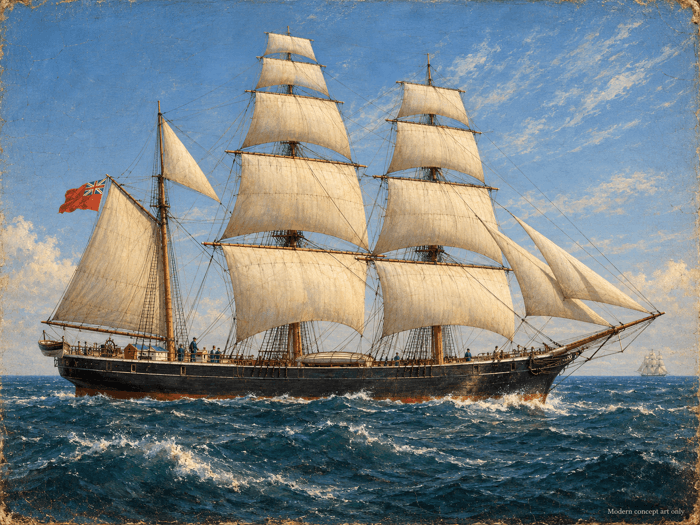
The Peruvian was a wooden barque of 304 tons, built at Arbroath in Scotland in 1841 by Alexander Stephen and Sons, and belonging to the port of Dundee[1][2]. By the mid-1840s she was owned by her master, George Pitkethly, with partners, and his wife Elizabeth sailed with him[3][4][5]. The Peruvian brought general cargo from London to Sydney in 1845 and tea from Hong Kong in January 1846[6][7].
She sailed from Sydney on 26 February 1846 with 130 logs of cedar, cleared for Lima, though everyone afterwards said she was bound for China[8][9][4]. Seven passengers were aboard, including two women, a baby, and a girl of about six. By the only list there is, made from one survivor's memory, she carried sixteen crew[10].
After a week of gales she struck a reef in the dark, early on Sunday 8 March 1846. The second mate was swept away when she struck, and the first mate, the captain's brother, was carried off in a swamped boat[10][11]. The other twenty-one built a raft from her masts. It broke away from the wreck and drifted west for 42 days. Fourteen died on it. Seven landed on the southern point of Cape Cleveland, near present-day Townsville, in about the third week of April[10][11].
Three of the seven died within days. The other four, the captain, his wife, an apprentice and the able seaman James Morrill, were found by Aboriginal people after a fortnight and taken in by the people of Cape Cleveland and Mount Elliot[10]. About two years later the apprentice died of illness, the captain sickened and died some six weeks after him, and Mrs Pitkethly four days after that[10][12][11]. Morrill said the people who sheltered them treated them with kindness throughout[13][14]. Morrill lived on with his adoptive people for seventeen years. On 25 January 1863 he walked up to an outstation of E. S. Antill's sheep run on the lower Burdekin and announced himself as a British subject and a castaway sailor[12][10]. He became a minor celebrity, published his story in Brisbane, took a government post at Bowen, married, had a son, and died at Bowen in October 1865, aged 41[15][16].
Twenty-two of the twenty-three aboard died. Morrill was the only survivor[10].
The wreck itself was found about five weeks after the raft reached land. On 28 May 1846 the American whaler Pleiades boarded her, high and dry on a reef in 21°40′S, and set her on fire as a danger to shipping[17]. One Brisbane reprint of that report misprinted the latitude as 28°40′S, and that misprint is now the position in the Australasian Underwater Cultural Heritage Database (AUCHD)[18][19]. The evidence of 1846 places her on the south-eastern edge of the Bellona reefs, in waters that are now part of New Caledonia's (French) exclusive economic zone[20]. The wreck has never been located or surveyed.
The ship is filed in the AUCHD under 1846. Most of what is known about her loss comes from the man who walked out of the bush in 1863, and much of this page is his story.
Where was the reef?
The database record for the Peruvian gives three different answers to this question, and none of them agrees with the others[19]. It is worth settling before the story, because the answer decides whose waters she lies in.
What the record says. The AUCHD's "where wrecked" field reads "Booby Shoal (28.40 S 159.58 E)". Its cause field says she was wrecked "in the vicinity of Bellona or Minerva Reefs". Its latitude and longitude fields give −29.1667, 160.4667[19]. Those decimals are exactly 29°10′S 160°28′E: the record's own text position moved thirty minutes south and thirty minutes east. No source gives that position, and how it arose cannot be told from the record[19][20].
What the papers of 1846 printed. Captain Russell of the Pleiades, the only person known to have boarded the wreck, gave her position as 21°40′S. Every printing of his report was checked against the page scan[17][21][22][23][24][25][18]:
| Paper, date | Latitude | Longitude |
|---|---|---|
| Sydney Morning Herald, 8 Aug 1846 | 21·40 S | 159·58 E |
| Shipping Gazette, 8 Aug 1846 (same type as the Herald) | 21·40 S | 159·58 E |
| The Australian, 8 Aug 1846 (written separately) | 21·40 S | 159·50 E |
| Melbourne Argus, 14 Aug 1846 | 21.40 S | 159.58 E |
| Port Phillip Gazette, 15 Aug 1846 | 21·40 S | 159·58 E |
| Launceston Examiner, 22 and 26 Aug 1846 | 21° 40′ S | 159° 58′ E |
| Moreton Bay Courier, 5 Sep 1846 | 28·40 S | 159·58 E |
The verdict on the latitude. Russell's latitude was 21°40′S. The Moreton Bay Courier is a reprint of the Herald. It is a printer's error, and it is almost certainly where the AUCHD's "28.40 S" comes from[18]. The difference is seven degrees of latitude, about 420 nautical miles or nearly 800 km: the misprint moved the wreck from the Bellona reefs to the open sea east of Middleton Reef, off northern New South Wales. The longitude is less certain. The Herald and every paper that copied it give 159°58′E. The Australian, which wrote its own report, gives 159°50′E. Neither can be shown to be a misprint, so both are given here[17][21].
A second position. The first report of the wreck came from Captain Barr of the whaler Lucy Ann in June 1846. He placed her "on the Booby Shoal, it [in] lat 21·5 S., long. 159 E."[26]. That is about 64 nautical miles north-west of Russell's position. Barr's figure is within a few miles of where Matthew Flinders had charted Booby Shoal, at 21°2′S 159°2′E, so he may have been giving the chart position of the shoal he took her to be on rather than his own fix[27]. That is an inference. Barr's report is where the name "Booby Shoal" in the record comes from[26][19].
What Morrill said. Morrill gave no position. He reported the captain's warning the night before that they were "in the neighbourhood of Horse Shoe Reef, or the Minerva Shoal"[10]. On oath he said the reef was "supposed to be the Horse-Shoe reef"[11]. The captain had had no proper observation for days[12]. The charts of the 1840s placed the Minerva Shoal among the Bellona and Booby shoals, at about 21°S 159°E. They placed Horse Shoe Shoal far to the west, near the outer Barrier Reef at about 20°S 152°E[27]. The captain's "Horse Shoe" guess fits neither 1846 position. His "Minerva" fits both.
What is there. The reefs of this part of the Coral Sea are the Bellona reefs, a group of drying reefs and sand cays on an undersea plateau about 230 nautical miles east-north-east of Cato Island[28]. Measured in a straight line, Russell's position is about 410 nautical miles (760 km) from Sandy Cape, the nearest point of the Queensland coast. Modern sailing directions put Booby Reef at 21°01′S 158°34′E, Minerva Shoal at 20°55′S 159°22′E, Olry Reef at 21°26′S 159°34′E, and the western point of the South Bellona Reefs at 21°52′S 159°25′E[28]. Neither of Russell's positions falls on a reef: both lie in about 2,000 m of water, between 13 and 33 nautical miles east of the South Bellona and Olry reefs[29]. A whaler's longitude in 1846, worked out from a chronometer after weeks at sea, could easily be wrong by that much. The positions of the South Bellona reefs come from HMS Herald's survey of 1858–60[30], and the Admiralty's chart of 1861 still marked the ground to their east "Dangerous Ground not Surveyed"[31]. The positions of 28°40′S and 29°10′S lie in nearly 2,800 m and 1,700 m of open ocean, with no reef within 60 nautical miles[29].
The verdict. Every 1846 source, the captain's own reckoning and the AUCHD's cause field point to the same place: the south-eastern edge of the Bellona reefs, near South Bellona and Olry reefs, at about 21°40′S. The exact reef is not known. The record's "Minerva Reefs" invites confusion with the Minerva Reefs of Tonga, more than 2,000 km to the east, which have nothing to do with this wreck[28][19].
Whose waters. Both of Russell's positions lie in the exclusive economic zone of New Caledonia, which is French. The 159°50′E figure also falls inside France's contiguous zone[20]. The AUCHD's two positions both lie in Australia's zone, east of Middleton Reef, and the record files her under Queensland[20][19]. If the evidence of 1846 is right, the Peruvian was lost in what are now French waters. The consequences are set out under Protection and access.
Timeline
| Date | Event |
|---|---|
| 1841 | The barque Peruvian is built at Arbroath by Alexander Stephen and Sons (yard no. 25) for Alexander Pitcaithly of Newburgh, Fife[2]. |
| 1842 | Lloyd's Register lists her: master Pitkethly, 283/304 tons, owner "Capt.", belonging to Dundee, first voyage Dundee to New York[1]. |
| 1844–46 | Owners listed as "Capt. & Co"; voyages Liverpool to Bombay and Liverpool to Rio de Janeiro; hull coppered 1844[3]. |
| 1845 | 5 March - Sails from the Downs under George Pitkethly for Sydney[6]. |
| 5 July - Arrives at Port Jackson with general cargo, three passengers and a crew of 15[6][32]. | |
| 23 November - Sails from Hong Kong for Sydney with tea; Mrs Pitkethly the only cabin passenger[33]. | |
| 1846 | 14 January - Arrives in Sydney; lies at Moore's Wharf, discharging[34][35]. The whaler Pleiades is in harbour at the same time[35]. |
| 20 January - The Pleiades sails for the South Seas whaling grounds[36]. | |
| 23 February - Clears Customs for Lima with 130 logs of cedar and five listed passengers[37][9]. | |
| 26 February - Sails from Sydney (Morrill later remembered Friday the 27th, and in 1863 "the last day of February")[8][10][11]. | |
| 1–7 March - Gales; she runs under bare poles; on the 7th the captain warns of "Horse Shoe Reef, or the Minerva Shoal"[10]. | |
| 8 March, 3–4 a.m. - Strikes a reef. The second mate is lost at once; the first mate in the longboat at daylight[10][11]. | |
| 8–9 March - The raft of masts and spars is launched; that night it breaks its moorings and drifts away with 21 aboard[10]. | |
| About 30 March - A sail is seen on the 22nd day and lost; soon afterwards the first death, James Quarry[10][11]. (Date inferred from the day count.) | |
| About 19–20 April - After 42 days the raft lands on the southern point of Cape Cleveland with seven alive[10]. (Date inferred.) | |
| Late April - George Wilmot and James Gooley die; John Millar leaves in a bark canoe and dies[10][11]. | |
| About early May - After fourteen days ashore, the four survivors are found and taken in by Aboriginal people[10]. (Date inferred.) | |
| 28 May - Capt. Edward Russell of the Pleiades boards the wreck on a reef in 21°40′S, takes her papers and sets her on fire[17]. | |
| 13–23 June - Capt. Barr of the Lucy Ann sees the wreck "on the Booby Shoal" and identifies her[38][26]. | |
| 17 July - First news of the wreck printed in Sydney[26]. | |
| 8 August - Russell's report printed: 21°40′S, 159°58′E[17]. | |
| 27–29 August - The Herald accuses Pitkethly of hiding Admiralty letters; his agents defend him[39][4][40]. | |
| 5 September - The Moreton Bay Courier reprints the report with the latitude misprinted as 28°40′S[18]. | |
| 1847 | The Peruvian disappears from Lloyd's Register[41]. |
| About 1848 | The apprentice dies; about six weeks later Capt. Pitkethly, and four days after him Mrs Pitkethly[10][11]. (Year inferred from "about two years".) |
| 1860–62 | Settlers reach the country between Cape Cleveland and the Burdekin; Morrill hears of shootings of the people he lives with by settlers and "black police"[10][42]. |
| 1863 | 25 January (Sunday) - Morrill makes himself known to the stockmen Hatch and Wilson at Antill's station on the lower Burdekin; gives himself up the next day[10][12]. |
| 20 February - Reaches Bowen[12]. | |
| 23 February - Swears a statement before Phillip Somer, J.P., at Bowen[11]. | |
| 5 March - Questioned by the Police Magistrate at Rockhampton[14]. | |
| 11 March - The Brisbane Courier prints his first account[12]. | |
| 14 March - Arrives in Brisbane; introduced to the Governor[43]. | |
| 21 April - Sketch of a Residence among the Aboriginals of Northern Queensland for Seventeen Years published[15]. | |
| May - Returns north with a government appointment at Bowen[44]. | |
| 1864 | 13 January - Sails with G. E. Dalrymple's party to found Cardwell, and keeps a journal[45]. |
| 20 September - Marries Eliza Ann Ross at Bowen[46]. | |
| 1865 | 27 June - Their son is born at Bowen[47]. |
| 30 October - Morrill dies at Bowen, aged 41; buried the next day[16]. | |
| 1963–64 | The Bowen Historical Society places an obelisk over his grave, dated 30 October 1963 and unveiled 26 January 1964[48][49]. |
| 2018 | New Caledonia makes the Bellona reefs strict nature reserves within its Natural Park of the Coral Sea[50]. Dortins's The Lives of Stories publishes the fullest modern study of Morrill's story[49]. |
| 2019 | 1 July - The Underwater Cultural Heritage Act 2018 commences; the AUCHD lists the Peruvian as protected under it[51][19]. |
The vessel
Her entry in Lloyd's Register, the annual list that underwriters used to judge a ship's age, build and condition, reads the same in every year from 1842 to 1846 except for the owner and the voyage[1][3].
| Field | Value |
|---|---|
| Rig | Barque (three masts, square sails on the first two, fore-and-aft sails on the last) |
| Master | Pitkethly |
| Tonnage | 283 tons old measure / 304 tons new measure |
| Built | Arbroath, 1841 |
| Owner | "Capt." in 1842; "Capt. & Co" from 1844 |
| Port belonging to | Dundee |
| Voyages listed | Dundee to New York (1842); Liverpool to Bombay; Liverpool to Rio de Janeiro (1844–46) |
| Class | A1 for seven years from 1841, the highest grade |
| Hull | yellow-metalled 1841; felted and coppered 1844 |
She was Scottish-built, on the east coast. The yard list of Alexander Stephen and Sons puts her at their Arbroath yard as yard number 25 of 1841, a barque of 283 tons, built for "Alex. Pitcaithly, Newburgh"[2]. Newburgh is a small port on the River Tay in Fife. The 283 tons in the yard list matches Lloyd's "old measure" figure exactly, which is good independent support for both[2][1]. The yard list does not say where its information came from, so it is treated here as a secondary source.
The two tonnages are both right. British ships of the 1840s were measured under two rules. Lloyd's printed both: 283 tons by the old rule and 304 tons by the new one introduced in 1836[1]. Every Sydney paper, both New South Wales arrival reports and the AUCHD use 304[34][6][19]. This page uses 304 tons.
She belonged to Dundee, not London. Lloyd's gives her port as Dundee in every edition from 1842 to 1846[1][3]. The memorial stone of Mrs Pitkethly's family in Dundee calls her the Peruvian "of Dundee"[5]. The AUCHD's "registered London" has no support in any source found. Its most likely origin is her 1845 voyage, which began in London[6][19].
Her master was also her owner, or one of them. Lloyd's shows the owner as "Capt.", meaning the master himself, in 1842, and as "Capt. & Co", the master with partners, from 1844[1][3]. Her Sydney agents called George Pitkethly her "commander and owner" in August 1846[4]. When she reached Sydney in 1845 part of her cargo was consigned to "G. Pitkethly" himself[32]. Whether the Pitkethly in the 1842 register was George or an older relative cannot be settled from Lloyd's, which gives no first names.
The master's name was George, and the spelling varies. The New South Wales Health Officer's report of July 1845 gives "George Pitkethly", and the Tide Surveyor's report of the same arrival gives "Geo Pitkethly"[6]. The Health Officer's report of January 1846 again gives George[33]. The newspapers print Pitkethly, Pitkethley and Petkithley, sometimes in the same week[34][7][35]. Morrill's 1863 book has Pitkethley[10]. The family's own stone has Pitkeathly, and the yard list has Pitcaithly for the first owner[5][2]. This page uses Pitkethly, the form in Lloyd's Register and in both 1845 manuscript reports. The AUCHD's "Pitceathley" was not found in any source consulted[19].
Her wife sailed with him. Mrs Pitkethly was Elizabeth, born Ruxton, the daughter of a Dundee vintner. The family stone records her as lost at sea with her husband, aged 28[5]. She was the only cabin passenger when the Peruvian arrived in Sydney from Hong Kong in January 1846[33]. One modern book calls her "Alice", but no document found supports that name[49].
There were other Peruvians. Lloyd's 1842 lists three ships of the name. One was another barque built in Scotland in 1841, at Glasgow, of 354 tons. The third was a ship built in New Brunswick in 1834 and owned in Liverpool[1]. Their records are easy to confuse with this one.
Her known voyages
Lloyd's lists a first voyage from Dundee to New York, then voyages from Liverpool to Bombay and from Liverpool to Rio de Janeiro[1][3]. The register's voyage column was often out of date, so these are the voyages it knew about, not a complete record.
She sailed from the Downs, the anchorage off the Kent coast where London ships waited for a wind, on 5 March 1845. She reached Port Jackson on 5 July with general cargo, two cabin passengers and one steerage passenger, and a crew of 15. Her agents were Thacker, Mason and Company[6]. The cargo included salt, wine, beer, tobacco, iron, copper sheathing and books[32].
When she left Sydney after that visit has not been found. She next appears sailing from Hong Kong on 23 November 1845, and she arrived in Sydney on 14 January 1846 with tea: about 2,600 chests and 3,700 half-chests, consigned to Thacker and Company[33][34][7]. Two men aboard were sick with intermittent fever, the old name for malaria[33].
The American whaling barque Pleiades, Captain Russell, was lying in Sydney Harbour at the same time[35]. Four months later her captain would be the man who set the Peruvian on fire.
The last voyage
Six weeks in Sydney
The Peruvian lay at Moore's Wharf from mid-January 1846, discharging her tea[35]. In the third week of January she was "advertised for Melbourne"[35]. That voyage never happened. The Shipping Gazette's list of ships in harbour still had her at Moore's Wharf on 7, 14 and 21 February, and by 7 February the Melbourne notice had gone[52]. The Sydney Morning Herald later said she "remained in port until the 26th February"[40].
Cedar for Lima
She cleared at the Customs House on Monday 23 February 1846. The Herald's list of exports gives her cargo as 130 logs of cedar, shipped by Thacker and Company, and her destination as Lima[9]. The list of clearances the same day gives her passengers[37]:
February 23.—Peruvian, barque, Captain Pitkethly, for Lima. Passengers—Mrs. Pitkethley, Mr. and Mrs. Wilmott, Mr. J. B. Quarry, and Miss Quarry.
The Herald's departures column for 27 February reports that she sailed on Thursday 26 February for Lima, with the same five passengers[8].
Lima or China? Every record made at the time of sailing says Lima: the clearance, the export entry and the departure list[37][9][8]. Every report written after the wreck says China. That includes the first news of the wreck in July, the Herald's editorial of August, and the letter from her own agents, who said Pitkethly "was then about to go back to China"[26][39][4]. Morrill, seventeen years later, also said China, on oath and in print[11][10]. A voyage to Lima with cedar and then on to China would reconcile them, but no source found says so.
The AUCHD gives the cargo as "hardwood timber"[19]. The source says cedar. Australian red cedar is botanically a hardwood, but the record of the day says cedar, and that is the word used here[9].
Who was aboard. The Customs House kept a list of passengers but none of the crew. When the editor Edmund Gregory asked for the ship's papers in 1863, the Collector of Customs sent him the five passengers' names and wrote that "No list of the crew can be found in this Office"[53]. Everything known about the crew comes from James Morrill's memory.
Morrill's list, printed in 1863, is the fullest there is[10]:
| Morrill's list (1863) | |
|---|---|
| Passengers | Mrs Pitkethly; Mr and Mrs Wilmott; Miss Wilmott, an infant; "a young nursegirl"; Mr J. B. Quarry and his daughter, about six years old |
| Officers | the captain; the captain's brother (first mate); "John ——" (second mate) |
| Tradesmen | the carpenter; John Millar (sailmaker); the cook |
| Able seamen | James Dicks; James Gooley; "Jack ——"; James Morrill |
| Apprentices | James Wilson; "William ——"; "James ——"; one more |
| Others | "two black men", stowaways working their passage |
That is seven passengers and sixteen of the ship's company, twenty-three people in all. Morrill added that the captain, officers and apprentices "were all of Dundee", and that he gave the names "as far as possible from memory"[10]. He noted that the Customs list was two short, missing the Wilmott baby and the nursegirl[10].
How big was the crew? Two months before the book, Morrill gave a sworn statement at Bowen. In it he listed the same seven passengers, named the first mate as the captain's brother and the second mate as John, and said there were "twelve in the Ship's Company including two black men"[11]. The Courier account he gave at Bowen the same week puts "fourteen of the ship's company" on the raft[12]. An 1863 British summary says fourteen crew and seven passengers[54]. The book's sixteen, itemised man by man, is the fullest list, and its numbers add up to the twenty-one on the raft. It is used here, with the caution that Morrill's own count changed between February and April 1863.
The newspapers of 1846 add a little. The Australian described the Wilmots as travelling with "three children and servant"[55]. One July report listed a "Mr. Pitkethly" among the passengers, which may be the captain's brother or a misprint for Mrs[26]. An 1863 account says the passengers were from the Port Phillip district, now Victoria[54].
The sailing date. Four dates are in circulation:
| Date | Source |
|---|---|
| 24 February 1846 | AUCHD, "departed"[19]; Morrill's book gives this as the day he signed on, a Tuesday[10] |
| 26 February 1846 (Thursday) | the port record, Sydney Morning Herald departures[8] |
| 27 February 1846 (Friday) | Morrill's book, "the sailor's unlucky day (Friday)"[10]; the Australian Dictionary of Biography[56] |
| "the last day of February" (Saturday 28th) | Morrill's sworn statement and his Courier account, both February 1863[11][12] |
The port record is the only one made at the time, and this page uses 26 February. A ship listed as departed could take another day to get clear of the Heads, so Morrill's Friday may describe the same departure. The AUCHD's 24 February is the day Morrill says he joined the ship, not the day she sailed.
Mail she did not deliver
One more thing went with her out of Sydney. When the Peruvian arrived in January the captain had declared only two letters, and he delivered them to the Post Office[40]. After the wreck, six or seven more were found in his cabin. They were addressed to officers of HMS Castor, North Star and Hazard, carried London and Calcutta postmarks, and were nearly all marked as from the Admiralty or the Commander-in-Chief[40]. That story belongs to August, and is told in The hulk and the Pleiades.
The wreck
Everything in this section comes from one witness, James Morrill, and he told it three times in 1863. On 23 February, three days after reaching Bowen, he swore a short statement before a magistrate[11]. Two days later a local correspondent took down a longer account, printed in the Brisbane Courier in March[12]. In April the Courier office printed his own narrative as a pamphlet[10]. The three agree on everything that matters. Where they differ, the differences are given.
The gale. The first two days out were fine, with a fresh fair wind. On Sunday evening the weather turned threatening, and it blew harder every day after that. On the Tuesday her fine-weather sails blew out of their ropes and had to be replaced. By the Friday she was running "under bare poles", with no sail set at all[10]. In the Courier account the captain could take no observations of the sun to fix his position while the weather was so heavy[12].
The warning. On Saturday 7 March the weather began to break. The captain took sights, but it was very thick. That night, Morrill wrote[10]:
The captain said that we were in the neighbourhood of Horse Shoe Reef, or the Minerva Shoal, and told us to keep a good look out for broken water.
On oath he put it more simply: after nine days at sea the ship struck "on a reef supposed to be the Horse-Shoe reef"[11]. Where that reef was is the subject of Where was the reef?.
Morrill was in the second watch, under the second mate. He had the wheel from midnight to two and then handed it to the eldest apprentice[10].
The strike. Between three and four in the morning of Sunday 8 March 1846, the watch saw "what appeared to be land or a dark cloud dead a-head"[10]. The date is worked out from Morrill's days of the week, and it agrees with his own statement in 1863 that it was seventeen years "on the 8th March"[12]. He went on[10]:
The second mate went down and told the captain, and immediately returned on deck; he had hardly done so, however, when she struck with great force on a rock, and the first sea that struck her lifted her partly on the rock, and swept one of the boats and the second mate overboard, who was never afterwards seen. The next sea that struck her lifted her wholly on the top of the rocks, where she stuck fast; the first shock knocked her bilge off ...
The bilge is the broad, rounded part of the hull's bottom. Most of the people aboard came on deck in their night-clothes. Not knowing where they were, they sheltered behind the cuddy, the cabin structure on the after deck, until daylight[10].
Daylight. Morrill described what they saw[10]:
At daylight a terrible scene presented itself, as far as the eye could reach there were the points of the rocks awash, but no friendly land in view.
The captain ordered the jolly boat, the smallest boat, lowered. It was smashed to pieces in the broken water as soon as it reached it. That left the longboat, which Morrill called "old and shaky". As soon as it was put over the side it filled with spray. The captain ordered men into it to bail. None would go except the first mate, the captain's brother[10]:
Before he had got out a couple of buckets the stern post was jirked out of her and left hanging in the tackles; at the same time the fore tackle got adrift, and she was carried away from the wreck with the force of the current. Lines were thrown out, but none reached him. There was a live sheep in the boat beside the mate. He then calmly sat in the bows of the boat, and bid good bye to his brother and sister, awaiting the will of God: presently he disappeared from sight, and was seen no more.
The Courier version has him wave his hand and say goodbye "to his brother and sister-in-law"[12]. His first name is not given in any source found.
Two deaths, and twenty-one left. The second mate and the first mate were the only people lost at the wreck itself[10][12].
Forty-two days on the raft
Building it. With no boats left, the crew cut away the mizzen mast and then the mainmast. These came down with their sails still flying and tangled, but with them and some spare spars from the deck there was enough timber. They lashed and nailed the spars together, rested partly on the rocks and partly on the wreck, and fixed a mast and a raised platform of light spars in the middle, so that people could sit and lie out of the water. By the middle of the day on Sunday they had worked it off the ship and into the water[10].
What they had. The bread was spoiled by salt water. Most of the tinned meat, stacked on deck ready for the boats, had been washed overboard. Nothing that would hold water was left whole except one small keg[10]. They had a few tins of preserved meat, the keg of water and a little brandy, all in the captain's charge, with his instruments and charts, some blankets and some clothing[10].
Carried away. The plan was to stay by the wreck for a few days and perhaps build a boat from planks aboard. That night the current and the weight of the raft broke its moorings, and it was carried out to sea[10]. Morrill listed who was on it:
There were on the raft three ladies, two children, two gentlemen passengers, the captain, carpenter, sailmaker, cook, four able seamen, including myself, four apprentices, and two blackmen, stowaways, working their passage—in all 21 souls.[10]
Rations. They agreed to share the stores equally, "and that there should be no lots drawn to take away each other's lives"[10]. Each person had a tablespoon of preserved meat a day, and four measures of water poured into the neck of a glass bottle[10]. At first they caught a few seabirds, drank the blood and ate the flesh raw. Nearer the coast there were none. The weather was fine, with a light wind by day that died at sundown. The captain took sights from time to time[10].
The drift. Morrill reckoned the current and their small sail carried them about forty miles a day[10]. Gregory's 1896 edition keeps that figure[57]. That figure should be treated with caution. Forty-two days at forty miles a day is about 1,700 miles. The straight-line distance from the reef where the wreck was later found to Cape Cleveland is about 730 nautical miles, roughly 1,350 km[17]. Either the raft wandered a great deal or the daily figure is too high.
The sail. On the twenty-second day they saw a ship. It stayed in sight for about four hours and then disappeared. They had no way to signal to it[10]. In his sworn statement Morrill explained why: the raft was so low in the water that they could see only the ship's sails, so she could not have seen them[11].
The dying. A few days later the first person died. Morrill names him as James Quarry, the passenger, who said the day before that he would not live long[10]. His body was put over the side, and the sharks took it at once. In the book the Wilmots' baby was next, then Mr Quarry's little girl, then Mrs Wilmot. The burial service was read over each[10]. The sworn statement has the girl dying three or four days after her father, before the baby, and then one of the apprentices after Mrs Wilmot[11]. After that, Morrill wrote, they died "one after the other very rapidly", and he was too exhausted to remember the order of their names[10]. By elimination from his list, the others who died were the nursegirl, the carpenter, the cook, the able seamen James Dicks and "Jack", three of the four apprentices, and the two stowaways. That is inference from the list, and the order is unknown.
The sharks. The captain thought of a way to catch the sharks that followed the raft. The men cut off the leg of one of the dead and lashed it to the end of an oar as bait, with a running noose on a second oar. A shark came through the noose for the bait, and they killed it with the carpenter's axe[10]. An 1863 summary of Morrill's story says they caught three sharks this way[54].
The Barrier Reef. Near the end the raft was driven down onto the Great Barrier Reef by a strong current. They got it over the reef into deep water before dark. Two days later they saw land, which Morrill thought was Cape Upstart, and drifted past it in the night. Two or three days after that they were driven towards Cleveland Bay. A land breeze pushed them out again just as they were getting ready to go ashore[10].
Ashore. That night the sea breeze brought them back, and about midnight they landed on the southern point of Cape Cleveland[10]. It rained, and they filled their tins from the rock pools. The captain had cut a notch in a piece of wood every day on the raft. There were forty-two. Of the twenty-one who had left the wreck, seven were alive: the captain, his wife, Mr George Wilmot, Morrill, the able seaman James Gooley, the sailmaker, and one of the apprentices[10].
Counting forty-two days from the night of 8 March puts the landing at about 19 or 20 April 1846. No source gives that date; it is derived.
A note on the count. Every version of Morrill's story agrees on twenty-one on the raft, forty-two days and seven landed[11][12][10][53][57]. The book's itemised list gives twenty-three aboard and two lost at the wreck, so fourteen died on the raft[10]. The AUCHD gives seventeen crew and eight passengers, twenty-five in all[19]. No source found supports twenty-five. The AUCHD's figure of twenty-two deaths fits Morrill's twenty-three aboard, less Morrill himself. The total aboard is the least certain number in the story: the sworn statement's "twelve in the Ship's Company" would make it fewer[11].
Cape Cleveland
The first days. At low tide, the captain, the strongest of them, went along the rocks and came back for the axe. He brought rock oysters, which grew in large clusters on the rocks, and they lived on these[10]. Within a few days George Wilmot and the able seaman James Gooley were too weak to go on. They lay down by a waterhole and died[10]. In his sworn statement Morrill said the two died "somewhere" after three or four days, and that the captain saw their bodies but he did not[11].
The sailmaker. On one of his walks the captain found a bark canoe, with fishing lines and spears, left by a party of Aboriginal people who had evidently fished there in the rainy season[10]. The sailmaker, John Millar, whom Morrill also calls Jack, decided to take the canoe and go for help, and left alone the next morning[10][53]. He was never seen alive again. Aboriginal people later found his body on the shore of the next bay, starved, and told Morrill where[10][11].
Four left. That left the captain, Mrs Pitkethly, Morrill and one apprentice. The boy had two large boils on his leg and could not keep up with the others[10]. Who he was is not settled. The Courier account of March 1863, the only early source to name him, calls him James Wilson[12]. The Australian Dictionary of Biography calls him White[56]. No source earlier than 1967 was found that gives White, and the sworn statement does not name him at all[11]. This page uses "the apprentice", and James Wilson where a name is needed.
Found. After fourteen days on the shore the four were seen by Aboriginal people[10][11]. Morrill was told later that for several nights the people had seen falling stars in one direction, the direction of the rocks where the castaways were. Following that sign, they found fresh tracks and then the boy's camp fire[10]. Morrill remembered Mrs Pitkethly's words when the men appeared:
She exclaimed—"Oh George, we have come to our last now, here are such a lot of the wild blacks."[10]
They had not. After some discussion the men took the four to their camp, five to eight miles away, carrying the boy on their backs[10][49]. On the way, and at the camp, the finders performed a corroboree, a ceremony of song and dance, that told the story of what they had found. It was repeated night after night for visiting groups[10][49]. The castaways, too weak to join in, sang a hymn instead[49].
Claimed as kin. Morrill described how the four were divided between two groups:
There were present representatives of two different tribes—the boy and myself were claimed as relatives of one tribe who had jumped up white-fellows—they camped about Mount Elliott: and the captain and his wife were similarly claimed by the tribe belonging to Cape Cleveland.[10]
Mount Elliot is the mountain behind Cape Cleveland, south of present-day Townsville. No source of 1846 to 1865 gives a name for either group. Emma Dortins, in the fullest modern study, uses the language-group name Birri-gubba, following the advice of Eddie Smallwood, Chairman of the Gudjuda Corporation, and notes that others link Morrill to the Bindal and Juru clan groups[49]. James Cook University's record for the 1863 book says Bindal people cared for him around Mount Elliot and that he spent time with Juru people to the south[58]. This page follows those sources and does not assign a group on its own authority.
Fifteen months together. The sworn statement says the four lived together for about fifteen months. Then their hosts separated them into three parties, because it was hard to find enough food for all of them in one group[11]. The book tells it differently: the four slipped away with a group going south, were scattered among different groups, and the boy went further south than Morrill[10]. Both say that from then on they lived apart.
The deaths of the Pitkethlys
Nearly two years after they landed, news reached Morrill that the boy had died, and that his body had been burnt as the people did with their own dead[10][11]. About six weeks later, according to the book, the captain fell ill and died. The Courier account says two months, and the sworn statement "a month or six weeks"[10][12][11]. Morrill believed the boy's death and his wife's situation broke the captain's spirit[10].
Morrill had gone off hunting and fishing, unable to bear watching. Before he left he asked the people to bury the captain in the ground rather than burn him, and they did. When he hurried back, Mrs Pitkethly had died too, four days after her husband[10]. The Courier account says the two "were buried side by side by the natives"[12]. In the sworn statement Morrill said he had seen them about a fortnight before they died, and that the people told him they had buried the captain and his wife and burnt the boy[11].
These deaths fall around 1848. No source gives a closer date. Elizabeth Pitkethly's family in Dundee believed she had been lost at sea in May 1846[5].
Morrill was now the only one of the Peruvian's twenty-three left alive. He said on oath that he never saw another white person from then until he walked into Mr Antill's station in 1863[11].
The hulk and the Pleiades
While the four survivors were being taken in at Cape Cleveland, the wreck was being found, far out in the Coral Sea.
Russell, 28 May 1846. Captain Edward Russell's American whaler Pleiades, out of Wareham, Massachusetts, had been in Sydney Harbour at the same time as the Peruvian, and sailed for the South Seas on 20 January[59][35][36]. On 28 May he came on a wreck "high and dry on a reef". He boarded her[17]:
Her hull had been much stove in the bottom forward, through which the water rushed at high tide; her mainmast and mizenmast were gone, but the foremast and fore-topmast were standing, with the topsail and foresail hanging from the yards.
"Stove in" means broken inwards. The missing main and mizzen masts are the ones Morrill says the crew cut down to build the raft[10]. Russell's men searched for any paper explaining how she had been left, and found none. The cabin was strewn with women's clothing. Those who went aboard thought the boats had been washed away and that the people had built a raft[17]. Russell took the ship's papers and letters, and then, "Fearing that some other vessels would be led into danger by the wreck", he set her on fire[17].
Barr, June 1846. Barr's whaler Lucy Ann cleared Sydney on 13 June[38]. Within ten days she found a wreck "on the Booby Shoal". The surf was breaking too heavily to board, but Barr took a boat close enough to see that she was the Peruvian, high and dry, with nobody aboard and all her boats gone[26][55]. The news passed from the Lucy Ann to the whaler Pocklington on 23 June, then to the schooner Ariel on 3 July, which brought it to Sydney. The Herald printed it on 17 July[26]. It was the first anyone in Sydney knew of her loss.
Russell's own report arrived with the Pleiades on 7 August and was printed the next morning[17]. The Australian said it confirmed the loss[21].
One wreck or two sightings that do not fit? Barr saw the hulk at least two weeks after Russell says he set it on fire, and the reports of his sighting say nothing about fire damage[26][17]. The two positions are also about 63 nautical miles apart (see Where was the reef?). A burning hull stranded on a reef might not burn away completely, and a whaler's position given as a named shoal might be a chart position rather than a fix. Both explanations are possible; neither is proved. The Pleiades' logbook would settle it, and none is known to survive[59].
The letters in the cabin
Among the papers Russell brought back were six or seven letters that should not have been there. The Herald reported on 27 August that the captain of the Peruvian had concealed mail, and said "defence there can be none"[39]. Thacker and Company, her agents, replied the same day. The letters were private, they said. They had been given to Pitkethly in China for officers of HMS Castor and North Star, and he had kept them to take back when those ships could not be found. They asked readers to remember "her highly respectable commander and owner, who is in all probability now no more"[4].
The Herald answered two days later with more detail. On arrival in January the captain had declared only two letters. The letters found in the wreck were addressed to officers of the Castor, North Star and Hazard, bore London and Calcutta postmarks, and were nearly all endorsed as from the Admiralty or the Commander-in-Chief. HMS North Star had been in Sydney from 10 to 25 February, while the Peruvian lay at Moore's Wharf[40].
By then the Peruvian's owner, master and crew were presumed lost with all hands. Nobody in Sydney knew that four of them were alive at Cape Cleveland.
Seventeen years
This is the part of the story with the least evidence. Everything here comes from what Morrill said in 1863, after he came back, and he said much more about the people he lived with than about dates.
One of them. After the misunderstanding over the four castaways was settled, Morrill wrote, he lived "year after year in the tribe as one of themselves"[10]. He learned the language and could speak eight of the dialects of the district, and he said "They have no chiefs—the strongest is the best man"[10]. His name among them, he told the Courier's correspondent, was Karckynjib Wombil Moony, "after one of their chiefs"[12]. He mentions a brother-in-law, so he had kin by marriage[10]. An old knee wound from these years troubled him until his death[16].
Where he lived moved over the years: about Mount Elliot, at the place that became Port Denison (Bowen) when the captain died, and in his last years between Cape Bowling Green and the Burdekin River, which the people called Mall Mall[10][42].
The settlers arrive. From 1860 news of white men began to reach him, and much of it was of killing. In September 1860 the Government schooner Spitfire surveyed the coast near Cape Cleveland. Its report said the local people attacked and were driven off. Morrill said a friend of his was shot dead from the boat, and another wounded[10]. Later, a report came in of white and black men on horseback near Cape Upstart "shooting down the tribe that I had been living with, when the Captain died"[10]. Then about fifteen men of a fishing party from his own group were shot dead[10]. A correspondent at Bowen in February 1863 called it "the recent unprovoked massacre of from fifteen to twenty"[42]. No source of the time gives a date, a place or the names of those who did it. In his book Morrill wrote that the people he lived with were far fewer than when he came among them, through "wars, fights, destruction by the settlers and black police", and what he called natural deterioration among the people themselves[10].
He also heard of killing the other way. In his sworn statement he said that four or five months before he learned of Bowen, the people told him they had killed a white man between the Burdekin and Haughton rivers[11].
The walk in, 1863
A message to carry. Morrill told the Aboriginal people he lived with that the white men had come to take their land[10]. When he left, they asked him to carry a request. In the book's words, they asked "the white man to let them have all the ground to the north of the Burdekin, and to let them fish in the rivers; also the low grounds, they live on to get the roots—ground which is no good to white people, near the sea-coast and swampy"[10]. The Bowen correspondent reported the same plea: at least "the swamps and the salt water creeks"[42].
Sunday 25 January 1863. Morrill had persuaded his companions to hunt kangaroo on a hill, Yamarama, about half a mile from a sheep station on the north bank of the lower Burdekin belonging to Mr E. S. Antill[10][12]. The first printed notice of his return placed the station "in the rear of Cape Bowling Green"[60]. He washed himself, climbed onto the rails of the stockyard, and called out "What cheer, shipmate"[12]. A man came out of the hut, saw him, and called to his mate: "Come out here, Bill". They came out with a gun[12]. The stockmen were named Hatch and Wilson. Wilson had been a sailor himself. A third man, a Scot named Creek, came home later with the flock[10]. They told Morrill it was Sunday 25 January 1863[10]. He went back to his people for one more night, and gave himself up the next morning[10].
"British subject" or "British object"? The most quoted line in the story exists in several versions[12][42][10][56]:
| Version | Source |
|---|---|
| "do not shoot me, I am a British subject, a castaway sailor" | Courier, 11 March 1863, from Bowen, 25 February |
| "I am a shipwrecked sailor, you would not shoot a British subject" | Rockhampton Bulletin, 7 March 1863, from Bowen, 25 February |
| "do not shoot me, I am a British object—a shipwrecked sailor", followed by "Of course I meant subject" | Morrill's Sketch, 21 April 1863 |
| "Don't shoot, mates, I'm a British object!" | Australian Dictionary of Biography, 1967 |
The two earliest printings, both written at Bowen a month after the event, say "subject"[12][42]. The famous slip first appears in the book, written in Brisbane with the help of the Courier's Edmund Gregory, together with Morrill's explanation[10][53]. It is not later folklore, but it is not the first version either. The "mates" in the dictionary's version appears in no 1863 text found.
The date. The book and the sworn statement give 25 January 1863[10][11]. Dortins gives 26 January for the first meeting, which looks like a slip for the next day, when he gave himself up[49].
Which station? All the 1863 sources say Antill's station on the lower Burdekin, and the sworn statement says "Mr Antill's Station"[12][11]. None names the run. Dortins calls it an outpost of Inkerman Station[49]. Other accounts call Antill's run Jarvisfield. That needs a primary source, and is listed under Gaps and uncertainties.
To Bowen. Morrill stayed about a fortnight at the station. He was then handed to a Mr Myers, who left him with Mr Salting of Hiffling's cattle station, until the Commissioner's orderly returned from the Fanning River and took him into Bowen[10][12]. He reached the town on Friday 20 February 1863 in the charge of W. H. Thomas[12]. On 23 February he swore his statement at the Police Office before Phillip Somer, Justice of the Peace[11]. The townspeople raised £35 for him[13].
South. He went south by the steamer Murray[13]. At Rockhampton on 5 March the Police Magistrate, John Jardine, questioned him in the court-house before more than a dozen onlookers. Morrill said the Aboriginal people had treated him and his shipmates with unvarying kindness[14]. He reached Brisbane in the steamer Queensland on Saturday 14 March, to a crowd on the wharf, and was introduced to the Governor[43]. On 21 April 1863 the Courier printing office published his Sketch of a Residence among the Aboriginals of Northern Queensland for Seventeen Years, twenty-four pages long[15]. A month later it was advertised in its second thousand, at a shilling, "For the Mail to England"[15].
Bowen, 1863–1865
A job. Morrill went back north in May 1863 with a government appointment. The Rockhampton Bulletin reported it as "Colonial Storekeeper" at Bowen, and mocked it as "the charge of colonial candles and dispensation of official soap"[44]. The Government sent blankets, fish-hooks and tomahawks with him for the people who had sheltered him[44]. At his death he was described as the bonded warehouse-keeper at Port Denison, the keeper of the Customs store for goods on which duty had not yet been paid[16][53]. The notice of his appointment in the Government Gazette, with its date and salary, was not found.
Cardwell, 1864. In January 1864 he sailed from Port Denison in the Policeman with G. E. Dalrymple's party to found a settlement at Rockingham Bay, which became Cardwell. His journal of the expedition was printed in the Port Denison Times and reprinted elsewhere[45]. It shows him acting as the party's spokesman to the Aboriginal people of that coast. On 21 January he wrote[45]:
I then said that they must clear out and tell others to do so, as we wished to occupy the land, and would shoot any who approached; that we were strong, and that another party would soon follow.
Three days later, by the same journal, armed Aboriginal men waiting behind the camp were set upon by Dalrymple's men[45]. Dortins reads a later entry, about a petition over land, as being on behalf of the Aboriginal "inhabitants" and dates it January[49]. The printed journal dates it Monday 14 March and says "present holders": the settlers already on the new town's allotments[45].
Marriage and a son. On 20 September 1864 Morrill married Eliza Ann Ross, formerly of County Armagh, Ireland, at Bowen. The Rev. James Reid officiated[46]. The Australian Dictionary of Biography says the church was Presbyterian and that she was a servant in the police magistrate's household[56]. Their son was born at Bowen on 27 June 1865[47].
The Ariel. The dictionary says that in April 1865 Morrill was aboard the schooner Ariel in charge of the first cargo of bonded goods for the new settlement on Cleveland Bay, later Townsville[56]. The Port Denison Times confirms that the Ariel was at Cleveland Bay, aground on the beach, in mid-April 1865, but no item found names Morrill[61]. The claim is plausible and unconfirmed. Later accounts that put him "in command" of the Ariel are wrong in any case: he was a Customs officer, not her master.
Death. Morrill died at Bowen on Monday 30 October 1865, aged 41[16][62]. The Port Denison Times said an old knee wound from his years with the Aboriginal people had been attacked by rheumatism, which brought on inflammation and fever[16]. Flags on the ships and stores were lowered to half-mast. The next day men from the pilot station carried his coffin, the police and the Mayor followed, and the Rev. E. Griffiths read the Church of England service[16]. His son survived him[16].
The obituary ended by imagining how the people of Mount Elliot would mourn if they knew[16]. The dictionary's statement that Aboriginal people came in for a mourning ceremony is not supported by the obituary, which describes the funeral in detail and mentions none[56][16].
The grave. Morrill was buried in the Bowen cemetery, now the Bowen General Cemetery on John Street[63]. The grave was unmarked for nearly a century[49]. The Bowen Historical Society placed an obelisk over it, with a plaque dated 30 October 1963, the anniversary of his death, and it was unveiled on 26 January 1964[48][49]. The cemetery is on the Whitsunday local heritage register, though not on the Queensland Heritage Register[63].
Those aboard
The Customs House in Sydney recorded five passengers and no crew[53]. The list below is Morrill's, as printed in 1863, with what other sources add. Morrill gave names "as far as possible from memory", seventeen years on[10]. Where he gave none, none is given here.
| Name or role | What happened | Sources and notes |
|---|---|---|
| George Pitkethly, master and owner | Survived the raft; lived with the Cape Cleveland people; died about 1848; buried at Morrill's request | Spelled Pitkethly in Lloyd's and the 1845 arrival reports[3][6]; Pitkethley and Pitkittley by Morrill[10][11]; Pitkeathly on the family stone[5] |
| Elizabeth Pitkethly, born Ruxton, the captain's wife, aged about 28 | Survived the raft; died four days after her husband | First name and age from the family stone in Dundee[5]; Morrill never names her. "Alice", in a modern book, has no source found[49] |
| Mr Pitkethly, first mate, the captain's brother | Lost at the wreck, carried away in the swamped longboat | First name unknown[10]. One July 1846 report lists a "Mr. Pitkethly" among the passengers[26] |
| John (surname unknown), second mate | Swept overboard when she struck | [10][11] |
| The carpenter (name unknown) | Died on the raft | [10] |
| John (Jack) Millar, sailmaker | Landed; left alone in a bark canoe to find help; found dead in the next bay | "John Miller, A.B." in the Courier account[12]; "John Millar" in the book's list, "Jack Millar" later in it[10] |
| The cook (name unknown) | Died on the raft | [10] |
| James Dicks, able seaman | Died on the raft | [10] |
| James Gooley, able seaman | Landed; died within days by a waterhole | "James Gouly" in the Courier[12][10] |
| Jack (surname unknown), able seaman | Died on the raft | [10] |
| James Morrill, able seaman, aged about 21 | The only survivor; seventeen years with Aboriginal people; died at Bowen, 30 October 1865 | Born at or near Maldon, Essex, in 1824[56][46]. Spelled Morrell and Murrells in some sources; Gregory's 1866 edition gives Murrells as the correct form[53] |
| James Wilson, apprentice | Named by Morrill as one of the four apprentices; probably the one who landed and died about 1848 | The Courier names the surviving apprentice as James Wilson[12]. The ADB's "White" has no earlier source found[56] |
| William (surname unknown), apprentice | Died on the raft, if Wilson was the survivor | [10] |
| James (surname unknown), apprentice | Died on the raft, if Wilson was the survivor | [10] |
| A fourth apprentice, unnamed | Died on the raft, if Wilson was the survivor | Morrill's eldest apprentice took the wheel from him at 2 a.m.[10] |
| Two black men, names unknown, stowaways working their passage | Died on the raft | [10][11] |
| George Wilmot (Wilmott), passenger | Landed; died within days by a waterhole | [10][37] |
| Mrs Wilmot, passenger | Died on the raft | First name not found[10] |
| Miss Wilmott, an infant | Died on the raft | Not on the Customs list[10] |
| A young nursegirl (name unknown) | Died on the raft | Not on the Customs list[10] |
| J. B. Quarry (James Quarry), passenger | The first to die on the raft, soon after the 22nd day | "J. B." on the 1846 lists and the Customs letter[37][53]; "James" in Morrill's narrative[10] |
| Miss Quarry, his daughter, about six | Died on the raft, a few days after her father | [10][11] |
Who the passengers were. Nothing more was found. An 1863 British summary says the passengers came from the Port Phillip district and had been thought lost in Torres Strait[54]. The Australian in 1846 called the Wilmots' party "three children and servant", which does not match Morrill's one baby and one nursegirl[55][10].
Dundee. Morrill said the captain, officers and apprentices were all from Dundee[10]. The ship's crew agreement would name them. No copy was found.
The wreck today
Never found. No search for the Peruvian, no survey and no find has been recorded. The AUCHD record lists no site images and no artefacts[19]. What Russell saw in May 1846 was a hull already broken open on a reef top, which he then set on fire[17]. Anything left today would be what survives of a burnt wooden ship on an exposed reef after 180 years: perhaps ballast, iron fastenings and the copper sheathing put on her in 1844[3].
The Bellona reefs today. The South Bellona reefs are two drying reefs and a detached cay, and the sailing directions note that the cay was reported in 1988 to have gone[28]. Olry Reef lies on the south-eastern side of the plateau. Between the shoals there is still dangerous ground that has never been surveyed[28]. The nearest shallow water to Russell's position is 13 to 20 nautical miles to the west, on the edge of the South Bellona and Olry reefs[29].
The landing place. Morrill's "southern point of Cape Cleveland" is the only description of where the raft came ashore[10]. An 1863 summary says the north side[54]. Modern local accounts name particular beaches, but no source behind them was found, and none is named here.
Morrill's grave is the one physical place in the story that can be visited. It is in the Bowen General Cemetery on John Street, marked by the Bowen Historical Society's obelisk of 1963–64[63][48].
Protection and access
What the record says. The AUCHD lists the Peruvian as protected under the Underwater Cultural Heritage Act 2018, with "Australian Federal" responsibility, in Queensland's Coral Sea region[19]. The Act came into force on 1 July 2019 and replaced the Historic Shipwrecks Act 1976[51].
Why that may not hold. The Act protects automatically the remains of every vessel that has been in "Australian waters" for at least 75 years, whether or not anyone knows where they are. "Australian waters" means the territorial sea and the sea above Australia's continental shelf[51]. A wreck outside Australian waters is protected only if the Minister makes a declaration that it is of heritage significance to Australia[51]. No such declaration for the Peruvian was found.
The AUCHD's own coordinates, and the misprinted 28°40′S, fall in Australia's exclusive economic zone. On those positions the automatic protection would apply, though beyond the contiguous zone only to Australians[20][51]. But the evidence of 1846 places the wreck at about 21°40′S, near the Bellona reefs, inside New Caledonia's zone[20]. If that is right, the Australian Act does not reach her, and the AUCHD's protection entry rests on a misprint.
French waters. The whole of New Caledonia's exclusive economic zone has been the Natural Park of the Coral Sea since 2014. In 2018 New Caledonia made the drying reefs of the Bellona group, including South Bellona and Olry, strict reserves, and the rest of the plateau down to 1,000 m a nature reserve[50]. That order was replaced in 2022, and the current rules were not checked for this page. How French law on maritime cultural heritage applies in New Caledonia's waters was not checked either.
Australian marine parks. None of the four candidate positions lies in an Australian Marine Park. The Coral Sea Marine Park ends west of the Bellona reefs[64].
Access. There is nothing known to visit at sea. The Bellona reefs are remote and partly unsurveyed, more than 750 km from the Queensland coast[28]. Anyone who did find remains should report them, to the Australian Government under the Act if on the Australian side, or to the New Caledonian authorities if, as seems likely, on theirs[51].
What the record gets wrong
This wreck's record was built from a single survivor's memory and one misprinted newspaper, and it shows. These are the errors that circulate, and what the evidence says instead.
| Claim | Where it appears | What the evidence says |
|---|---|---|
| Wrecked at 28°40′S 159°58′E, "Booby Shoal" | AUCHD[19] | 21°40′S in every 1846 printing but one; 28°40′S is a misprint in the Moreton Bay Courier of 5 September 1846[18][17]. "Booby Shoal" is Captain Barr's identification, at 21°5′S[26] |
| Position −29.1667, 160.4667 | AUCHD coordinate fields[19] | Matches no source; it is the record's own text position shifted 30′ south and 30′ east, in 1,700 m of open water[29] |
| "Bellona or Minerva Reefs" | AUCHD cause field[19] | Bellona is right. "Minerva Reefs" is a group near Tonga; the Coral Sea feature is the Minerva Shoal, on the Bellona plateau[28] |
| Registered in London | AUCHD[19] | Belonged to Dundee in every Lloyd's Register 1842–46[3] |
| Departed 24 February | AUCHD[19] | Cleared 23 February, sailed 26 February[37][8]; the 24th is the day Morrill signed on[10] |
| Bound for China with hardwood timber | AUCHD[19] | Cleared for Lima with 130 logs of cedar[9]; China in later reports |
| 17 crew and 8 passengers | AUCHD[19] | Morrill's list gives 16 crew and 7 passengers[10] |
| "Seven passengers made landfall" | AUCHD[19] | Seven people landed, two of them passengers[10] |
| The apprentice White died soon after the four were found | ADB[56] | Named James Wilson in 1863; died about two years after landing[12][11] |
| "Don't shoot, mates, I'm a British object!" | ADB[56] | "British subject" in the first reports; "British object", explained as a slip, in the Sketch; "mates" in neither[12][10] |
| Morrill in charge of the Ariel and the first bonded goods to Townsville | ADB and later panels[56] | The Ariel was there; Morrill's part is not confirmed in any source of 1865 found[61] |
| Aboriginal mourners at his funeral | ADB[56] | The obituary describes the funeral and mentions none[16] |
| Wrecked on the Horse Shoe Reef, part of the Great Barrier Reef off Port Denison | Wikipedia list of shipwrecks in March 1846[65] | The captain's guess in the dark was "Horse Shoe Reef, or the Minerva Shoal"[10]; every 1846 position is at the Bellona reefs, far out in the Coral Sea beyond the Barrier Reef[17][28] |
| Found by Captain Towns' whaler Terror, on "the Horse Shoe or Keen's Reef" | A Sydney letter quoted in the Brisbane Courier, March 1863[66] | The 1846 finders were the Lucy Ann and the Pleiades[26][17]; Kenn Reef lies about 230 nautical miles west of the Pleiades position[30] |
| Wrecked at Cape Bowling Green; first death "James Murray" | E. B. Kennedy, 1914[67] | The wreck was days offshore; the first death was James Quarry[10] |
| Mrs Pitkethly was "Alice"; Eliza "Jane" Ross; the son born after Morrill died | Dortins 2018[49] | Elizabeth[5]; Eliza Ann[46]; the son was born on 27 June 1865[47] |
Two further points are genuine uncertainty rather than error. The size of the crew changed in Morrill's own tellings, from twelve on oath to sixteen in the book[11][10]. And the Lima-or-China question cannot be settled from what survives[9][4].
Gaps and uncertainties
Things this page could not establish, and where they would be found.
- Which reef. The 1846 positions are 13 to 33 nautical miles from the nearest charted reefs, and the two whalers' positions are 64 nautical miles apart[17][26][29]. The Pleiades' logbook would give Russell's own fix and the date of the burning. None is recorded for her 1845–48 voyage[59]. The whaling collections of the New Bedford Free Public Library, the Providence Public Library and Mystic Seaport are the places to ask. Lloyd's List for 1846–47 (Lloyd's Register Foundation, London) may record how London heard of the loss.
- Where the AUCHD's position came from. The record cites Stone's Encyclopedia of Australian Shipwrecks (2006), which was not consulted[19]. The Department of Climate Change, Energy, the Environment and Water, which keeps the AUCHD, could say where "Booby Shoal (28.40 S 159.58 E)" and the decimal position came from.
- Lima or China. The ship's papers, which Russell handed to Thacker and Company in August 1846, would settle it[17]. No Thacker and Company records are known to survive. The outward clearance papers may survive in the Customs records at Museums of History NSW.
- Ownership and the crew. The Dundee register of British ships for 1841 (Dundee City Archives, or National Records of Scotland series CE70) would give her registered owners and shares. Her crew agreement (The National Archives, Kew, series BT 98) would name the crew, including the first mate and the apprentices. Neither was consulted.
- The apprentice's name. James Wilson (the Courier, 1863) or White (the Australian Dictionary of Biography, 1967)[12][56]. The crew agreement would settle it. The Bowen Historical Society's The Story of James Morrill (1964) and Neville George's The "Peruvian" and James Morrill (Maritime Museum of Townsville, about 1989) may show where "White" came from. Neither was seen.
- The passengers. Who the Wilmots and the Quarrys were, and where they were going, was not found. Port Phillip shipping lists of 1845–46 and the Melbourne papers are the place to start[54].
- The size of the crew. Twelve, fourteen or sixteen, by Morrill's own varying accounts[11][12][10]. Only the crew agreement would settle it.
- The Aboriginal people. No source of 1846 to 1865 names the groups who took in the castaways. The group names here are those of modern sources[49][58]. The right names, and whether the families of Morrill's adoptive kin are known today, are matters for the Traditional Owners of the Mount Elliot and Burdekin country. The Gudjuda Corporation, whose chairman Dortins consulted, would be a place to start[49].
- The frontier killings of 1860–63. Morrill and the Bowen correspondent describe shootings of the people he lived with, but give no dates, places or names[10][42]. N. A. Loos's thesis on frontier conflict in the Bowen district (James Cook University, 1970) and the Native Police records at Queensland State Archives would be the next sources.
- The station. E. S. Antill's sheep run on the north bank of the lower Burdekin is not named in any 1863 source read; Inkerman and Jarvisfield are both given in later accounts[49]. The run lists in the Queensland Government Gazette of 1862–63 and the run files at Queensland State Archives would settle it.
- Morrill's appointment. The Government Gazette notice of his appointment at Bowen, with its date, title and salary, was not found.
- The Ariel. Whether Morrill went to Cleveland Bay with the first bonded goods in April 1865 was not confirmed[61][56]. Customs records for Bowen at Queensland State Archives may show it.
- The Pitkethlys' grave. A 1931 magazine article asked whether a grave was that of Captain and Mrs Pitkethly, and later local claims place their burial at different spots[49]. George Turner's article in Cummins and Campbell's Monthly Magazine, March 1931, is held by James Cook University Library and Townsville City Libraries, and was not seen.
- Searches not run. Trove's search front end stopped working after a single search on 10 October 2026, and every later newspaper item was found by web search, by walking pages, or from other sources' references. A full Trove search, with an API key, for "Peruvian" in 1846–47 and for Morrill in 1863–65 is the largest single gap. Several Trove items were found but not read, including the Queensland Guardian of 12 and 17 March 1863, the Argus of 18 March 1863 and the Rockhampton Bulletin's report of his death. The British press of December 1846 and May 1863, held by the British Newspaper Archive, was not searched. The Queensland birth, death and marriage indexes were not searched.
News stories from history
The Sydney Morning Herald, 17 July 1846 - the first news
The Ariel spoke the whaler Pocklington on the 3rd July, with 33 tuns black oil and 6 tuns sperm; she reported having spoken the barque Lucy Ann, on the 23rd June, ten days from Sydney, clean: this vessel had fallen in with a wreck on the Booby Shoal, it [in] lat 21·5 S., long. 159 E., the surf was breaking heavily at the time, but Captain Barr lowered a boat, and approached sufficiently near to ascertain that she was the Peruvian, which vessel left Sydney on the 26th February for China, with 130 logs cedar on board.[26]
(A report passed through three ships before it reached Sydney. "Clean" means the Lucy Ann had not yet taken a whale.)
The Sydney Morning Herald, 8 August 1846 - the Pleiades
Captain Russell states that he boarded her on the 28th of May last, when she was high and dry on a reef in lat. 21·40 S., long. 159·58 E. ... It was the general opinion of those who visited the wreck that the boats had all been washed away, and as no spare spars were on board, that a raft had been hastily constructed, upon which the crew and passengers had taken refuge. Fearing that some other vessels would be led into danger by the wreck, Captain Russell thought it prudent to set fire to her.[17]
(They were right about the raft. It had been gone eleven weeks, and the survivors had been ashore for five.)
The Sydney Morning Herald, 29 August 1846 - the letters
When the Peruvian arrived, the captain made a declaration that he had on board only two letters, which he had delivered at the Post Office. This was on the 14th January, and the Peruvian remained in port until the 26th February. After she had been wrecked, six or seven letters, addressed to the officers of H.M.S. Castor, North Star, and Hazard, are discovered, several of which bear the London and Calcutta postmarks, and they are nearly all endorsed as from the "Admiralty," or "the Commander-in-Chief."[40]
The Courier (Brisbane), 11 March 1863 - Morrill's own words
We were 42 days on the raft before we reached the land at Cleveland Bay, and out of the number saved, only the captain, his wife, Mr. Wilmot, and four of the crew, viz., James Morrill, A.B., James Wilson, apprentice, James Gouly, A.B., John Miller, A.B., reached the shore.[12]
The Maitland Mercury, 21 March 1863 - a request carried to the settlers
... enraged as they were by the recent unprovoked massacre of from fifteen to twenty of their number ... begged of him to induce the whites to let them have at least the swamps and the salt water creeks undisturbed, and they would give the upper rivers to the whites.[42]
(Reprinted from the Rockhampton Bulletin of 7 March 1863, from a correspondent at Bowen.)
The Port Denison Times, 1 November 1865 - the funeral
The men belonging to the pilot station had asked and obtained permission to act as bearers to their old comrade's remains; the police also attended and moved in the procession next the hearse; then came the Mayor, the Police Magistrate, followed by a long string of vehicles, horsemen and pedestrians.[16]
A note on the sources
Almost everything on this page comes from five bodies of evidence, and they are of very different weight.
Primary, and the backbone of the voyage. The Sydney shipping columns of 1845–46 and the New South Wales arrival reports give the ship, her master, her cargoes, her passengers and the dates, as recorded at the time[6][8]. Lloyd's Register gives her build and ownership[3]. The whalers' reports of June to August 1846 are the only first-hand evidence of the wreck itself, and every printing of the Pleiades report was checked against the page scan[26][17].
Primary, but one man's memory. Everything about the gale, the strike, the raft, the landing and the seventeen years rests on James Morrill. He told it three times in 1863: on oath at Bowen, to a newspaper correspondent two days later, and in his book in April[11][12][10]. The three agree on the shape of the story and on most numbers. They disagree on the size of the crew, the order of some deaths and how the castaways were separated. His book was written with the help of the Courier's Edmund Gregory, who later admitted rewriting it[53]. It was read here in the 1863 first edition, from the page images[10]. The sworn statement, which earlier writers believed had not been digitised, was read in full from the State Library of Queensland's scans[11].
Contemporary newspapers of 1863–65. These give his return, his journey south, his job, his journal of the Cardwell expedition, his marriage, his son's birth and his death[12][45][16]. Trove's search was out of action for this pass, so they are a sample, not a complete run.
Secondary, and flagged as such. Emma Dortins's The Lives of Stories is the best modern study of how Morrill's story was told and retold, and it mapped the archives[49]. It is wrong on a handful of facts, listed above. The Australian Dictionary of Biography entry of 1967 is the source of most popular accounts, and of several of their errors[56]. The AUCHD record is the reason this page exists, but its position, registry, departure date, numbers and protection status are all wrong or doubtful[19].
For the site today, modern sailing directions, bathymetry and boundary data were used to test the 1846 positions[28][29][20].
Not consulted. Stone's Encyclopedia of Australian Shipwrecks (2006), Loney's shipwreck volumes, the Bowen Historical Society's publications, Neville George's booklet, Bruce Breslin's books on Morrill, and the British press.
Further reading
- James Morrill, Sketch of a Residence among the Aboriginals of Northern Queensland for Seventeen Years (Brisbane, 1863), James Cook University Library's digitised copy: https://nqheritage.jcu.edu.au/724/
- Morrill's sworn statement, Bowen, 23 February 1863, State Library of Queensland OM74-92: https://digital.slq.qld.gov.au/delivery/DeliveryManagerServlet?dps_pid=FL4346668
- Emma Dortins, The Lives of Stories: Three Aboriginal-Settler Friendships (ANU Press, 2018), free to download: https://press.anu.edu.au/publications/series/aboriginal-history/lives-stories
- The Pleiades report, Sydney Morning Herald, 8 August 1846: https://trove.nla.gov.au/newspaper/article/12889001
- The AUCHD record, Shipwreck ID 2988: http://www.environment.gov.au/shipwreck/public/wreck/wreck.do?key=2988
- G. C. Bolton, "Morrill, James (1824–1865)", Australian Dictionary of Biography: https://adb.anu.edu.au/biography/morrill-james-2484