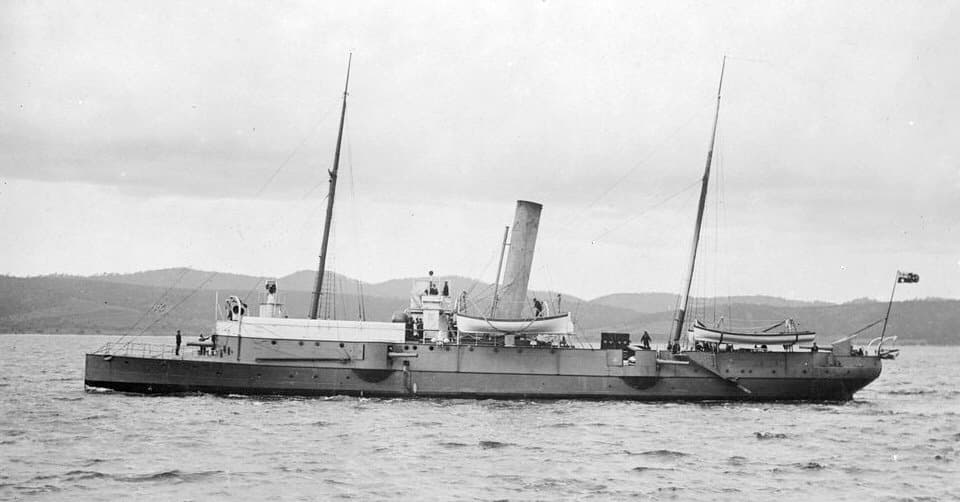
Saturday 22 April 1944, Gladstone Harbour. The hull leaving the harbour this morning is being towed by Cristian Poulson's motor launch and a handful of fishing boats. She is sixty years old, and all she has left to steer with is a wheel on the open deck at the back. She is a steel box 185 ft long, with a flat deck, two stumpy masts and a cargo hatch in the middle. The people on the tow ropes know her, if they know her at all, as the Sidney: the wool barge the Americans took over last year, and the one the tug put a hole in. Anyone who climbs aboard can read her earlier life off the deck. The posts at the front that the ropes are tied to are old gun mounts with timber stakes driven into them. The curved band of iron near the back is half of another gun mount. The strip of armour plate along her sides was meant to sit at the waterline, but it now rides a yard above it, because everything heavy has been taken out and sold at auction: the engines, the boilers, and the 8-inch gun that once fired further than any other gun in the colonies. Between the ribs of the hull, in the middle of the ship, is the cement the Navy poured in to plug her leaks and keep her afloat. Low on the left-hand side is the hole that has brought her here.
She is going to Heron Island, 72 km out on the Great Barrier Reef, to be sunk on purpose. A resort owner with no harbour has paid £10 for her. He means to lay her down beside a boat channel he has not yet blasted through the reef, so that his guests can come ashore without wading. It is a long tow for small boats, and somewhere past the harbour mouth they give up. Wind and tide carry her off, and she runs aground on Facing Island, in a quiet bay with the mainland behind her. Somebody takes her photograph there and writes on the back that she is at Heron Island. She is not. She does not get there, not this time.
When she does, a year or so later, she will be turned round outside the reef and reversed into place, back end first. A hole will be cut in her hull with a torch to let the water in, and her hold will be filled with broken coral to weigh her down. Then she will be left. Eighty years on she is still there, and still doing her job.
Watch the story
Summary
Protector was a steel gunboat built on the River Tyne in England for the colony of South Australia. She was launched on 27 December 1883 and entered service on 19 June 1884. She was the largest gunboat any Australian colony ever ordered, and the only ocean-going warship South Australia ever had[1][2][3]. She served for forty years under three different flags. For sixteen years she flew South Australia's, as a training ship and the flagship of the colony's volunteer Naval Brigade at Largs Bay. For five months in 1900 and 1901 she flew the Royal Navy's, when she went to China for the Boxer rising as HMS Protector and came home in time for the Federation celebrations. From 1901 to 1924 she flew the new Commonwealth's: as a training ship for part-time naval reservists, from 1911 as HMAS Protector, and in 1914 as escort to the submarines AE1 and AE2 on the way to Rabaul. There she captured the German steamer Madang, the only enemy ship she ever took[4][5]. She finished her naval life as a support ship (a "tender") renamed HMAS Cerberus. She was retired from service in June 1924 and sold for £677 10s. Her guns and engines were stripped out, and she was cut down into a cargo barge named Sidney, working in Port Phillip Bay at Melbourne[4][1].
In July 1943 the United States Army took over the barge to carry supplies to New Guinea. In September 1943, at Gladstone, a tug rammed her and tore a hole in her hull. The Army declared her not worth repairing. Early in 1944 Cristian Poulson, who ran the tourist resort on Heron Island but had no harbour for it, bought the stripped-out hull for £10[1][6]. His first attempt to tow her out, on 22 April 1944, ended with the hull aground on Facing Island. By 1945 he had her at Heron Island. A channel was blasted through the reef, and the old gunboat was reversed into place beside it, back end first. A hole was cut in her hull with a torch to let the water in, and she was weighed down with broken coral, so that she would stay put as the breakwater she still is today[1]. Nobody was killed in any of this. Poulson himself drowned off the island in November 1947[7].
This page is filed under 1943, the year of the collision, because that is the year the Australasian Underwater Cultural Heritage Database (AUCHD) gives her[2]. The database also calls her a sailing ship lost in a collision at Heron Island, which she was not; the corrections are in the gaps section below. In 2013 a team from the South Australian Maritime Museum, the University of Adelaide and the Western Australian Museum surveyed her and laser-scanned her into a 3D model. Their papers are the backbone of this account. She was surveyed again in 2024[1][8][9]. She is protected under the Underwater Cultural Heritage Act 2018 and lies inside the Great Barrier Reef Marine Park[2]. Her right-hand side has collapsed down to the waterline and the middle of the ship is falling in. The Queensland Government now asks the island's visitors not to swim around her[10][11]. The maritime archaeologist James Hunter, lead author of the survey papers, calls her the last vessel of her kind anywhere in the world[9].
Timeline
| Date | Event |
|---|---|
| 1862, 1870 | Russian warships call unannounced at Melbourne, Sydney and Hobart, and the colonies begin to think about defending themselves[1][12]. |
| 1877 | Colonel William Jervois inspects the colonies' defences, becomes Governor of South Australia in October, and in December recommends a 2,500-ton armoured warship (an "ironclad") at about £150,000[13][1]. |
| 1882 | 26 February to 3 March - Admiral Aslanbegov's squadron, Afrika, Vestnik and Plastun, lies in Holdfast Bay[14][15]. |
| April - Jervois's memorandum asks the Agent-General, the colony's representative in London, for drawings and a price quote from Sir William Armstrong and Company[13][16]. | |
| 13 July - both houses of the South Australian parliament vote for a cruiser-type warship[3][16]. | |
| 14 November - Armstrong's and Charles Mitchell's shipbuilding company merge[17]. 16 November - the contract is signed for "a 14-knot unarmoured twin-screw steel gunboat", delivery in fourteen months; Parliament borrows £72,000 for her[18][19]. | |
| 8 December - work begins at Low Walker as yard number 457[12][20]. | |
| 1883 | 27 December - launched[20][12]. |
| 1884 | February - Commander J. C. P. Walcot RN appointed to command[21]. |
| 19 June - official trial off the Tyne with the guns fired, averaging about 14.15 knots (26 km/h) over four hours; enters service[22][3]. | |
| 27 June - sails from the Tyne; Gibraltar 5–7 July, Malta 13–19 July, Suez 25–27 July, Aden to 7 August, Colombo 17–25 August; a seaman dies of typhoid on the Indian Ocean crossing[18][22]. | |
| 20–24 September - King George Sound[18][3]. | |
| 30 September - anchors off Semaphore, Adelaide's seaside port suburb, at about 6 a.m., flying the colony's flag; 3 October - into Port Adelaide, inspected by the Ministers and the Mayor[18][23]. | |
| 1885 | 12 October - Lieutenant W. R. Creswell joins as second-in-command; December - the rear end of a 6-inch gun blows open during the Proclamation Day salute and kills a seaman[24][13]. |
| 1888 | 13 July - the Star of Greece is wrecked at Port Willunga; the colony's lifeboat and rescue-rocket service (rockets that fired a line out to a ship in trouble) is put under Walcot and the ship[25][12]. |
| 1892–95 | The Government considers selling her for not less than £75,000, and reverses the decision[25]. |
| 1893 | July–August - Walcot resigns; Creswell succeeds him in command; the permanent crew is cut to twenty-one[25][3][24]. |
| 1900 | 2 July - South Australia offers the ship for China; 6 July - the offer is accepted; 4 August - 96 men enrolled at Largs Bay on a Royal Navy agreement[24][26][27]. |
| 6 August, 4 p.m. - sails from Port Adelaide under Clare; Sydney 10–12 August; 14 August - Creswell takes command at Brisbane and sails the next day; Townsville 18 August; Thursday Island 22 August[28][4][3]. | |
| 9 September - Hong Kong; 11 September - formally taken into the Royal Navy as HMS Protector; 19 September - sails north for Woosung, Shanghai and Wei-hai-wei[4][24]. | |
| 1 October to 6 November - Taku, Ching-huang-tao (mines lifted), Shan-hai-kwan and Wei-hai-wei, carrying messages, supplies and men[24][4]. | |
| 2 November - released; 7 November - leaves Wei-hai-wei; 18 November - handed back by the Royal Navy at Hong Kong; 24 November - sails for home[24][4]. | |
| 14 December - Brisbane; Creswell hands her back to Clare[3][24]. | |
| 1901 | 1 January - at Sydney for the inauguration of the Commonwealth; 6 January - home at Port Adelaide after 153 days and 16,000 miles[4][24]. |
| 1 March - transferred with the other colonial warships to the Commonwealth[4]. | |
| 1905 | April–May - tows Tasmania's torpedo boat from Hobart to Port Adelaide; 29 August - leaves for two months training Victoria's part-time naval reservists at Melbourne[29][30]. |
| 1911 | July - HMAS Protector in the new Royal Australian Navy; fitted with new boilers[4][5][3]. |
| 1912 | The 8-inch gun comes out and the front of the ship is built up to the level of the main deck, raising the bow about 4 m higher above the water[4][1]. |
| 1913 | A 6-inch gun is given to the Port Adelaide council and set up on the Semaphore foreshore[31]. September - becomes support ship to HMAS Cerberus, an old warship used as a floating naval base at Williamstown, Melbourne; cement is first used to plug leaks in her hull plates[4][1]. |
| 1914 | 28 August - sails from Sydney as support ship to the submarines AE1 and AE2 with the Australian Naval and Military Expeditionary Force[4][32]. |
| 13 September - intercepts and captures the German steamer Madang off Herbertshöhe[5][1]. 14 September - AE1 is lost with all hands[32]. | |
| 17 September to 4 October - guard ship at Rabaul after the German surrender, then home with HMAS Fantome[4]. | |
| 1915 | October to December - at the Cocos Islands reporting on the wreck of the German cruiser Emden and trying to recover material from it[4][1]. |
| 1919 | 21 June - loses her funnel in a Bass Strait gale off Cape Everard and is towed into Hobsons Bay on the 23rd[33]. 15 December - banned from the open sea and kept to the sheltered waters of Port Phillip and Western Port, because taking out her heavy guns has left her unsteady in the water[1]. |
| 1920 | May - carries the advance party to Flinders Naval Depot; 25 November - the Navy calculates that 35 tons of extra weight (ballast) would make her steady again[4][1]. |
| 1921 | 1 April - renamed HMAS Cerberus, support ship to Flinders Naval Depot, the new naval base on Western Port; the old warship that had carried the name becomes Platypus II[4][34]. |
| 1924 | 3 March - a hull survey finds a hole under the cement and advises against removing any more of it[1]. June - retired from service to be sold; sold to Mr J. Hill of Melbourne for £677 10s; guns, engines and machinery auctioned[4][3][1]. |
| 1929 | November - conversion to a cargo barge completed; her old ammunition rooms become a tank for about 300 tons of fuel oil[3]. |
| 1931 | Bought by Victorian Lighterage Pty Ltd, a Melbourne barge company, and renamed Sidney[35][4]. January 1932 - registered at Melbourne, 564 tons, official number 153939[36]. |
| 1932 | Cristian Poulson opens a tourist resort on Heron Island; he takes the lease of the island in 1936[7]. |
| 1943 | 12 July - taken over by the US Army's Small Ships Section, its fleet of local supply vessels, as S-226; her registration as a British ship is cancelled that year[37][36]. |
| 11 September - Heron Island is declared a national park[38]. | |
| September - rammed by a tug at Gladstone, which tears a hole in her hull, while she is being towed to New Guinea with army supplies[1][8]. | |
| 1944 | about January - the US Army declares her not worth repairing; Poulson offers £10 for the wreck and gets her[1]. |
| 22 April - Poulson's motor launch and a few fishing boats tow her out of Gladstone Harbour; they give up the tow and she runs aground on Facing Island[1]. | |
| 5 August - formally written off at Brisbane in the Small Ships Section's books[37]. | |
| 1945 | Floated off and brought to Heron Island; a channel is blasted through the reef with dynamite, and the hull is reversed into place along its southern side, a hole is cut in her with a torch to sink her, and she is filled with broken coral to weigh her down[1]. 22 December - three of Poulson's boat crew are lost when their dinghy drifts away while they are meeting guests offshore[39]. |
| 1947 | 12 July - Barrier Reef Airways' Catalina flying boats begin flying Brisbane–Gladstone–Heron Island[40][41]. 28 November - Poulson disappears off the island in a dinghy; the Supreme Court presumes his death in February 1948[42][43]. |
| 1951 | The Great Barrier Reef Committee's research station opens its first building[44]. |
| 1966 | The channel is deepened by dredging[1]. |
| 1974 | Stuart Kininmonth walks her intact teak deck[45]. |
| 1980 | P&O buys out the Poulson family; the University of Queensland takes over the research station[7][44]. |
| 1987 | September–November - the harbour is dredged again, and a turning area for boats and a jetty are built[46][1]. |
| 1990 | November - a Navy diving and trials support ship enters service as the second HMAS Protector; the Navy's newspaper recalls the old gunboat "beached at Heron Island in 1944"[47]. |
| 2005 | 4 October - the RAN Heritage Centre opens at Garden Island with her wheel in the lobby[48]. |
| 2010 | 1 March - the Navy's revised battle-honours list credits her with CHINA 1900 and RABAUL 1914[49]. |
| 2013 | 17 September - the Gladstone Observer announces the coming laser scan as a first for central Queensland[50]. |
| 27 September to 3 October - the South Australian Maritime Museum, the University of Adelaide and the Western Australian Museum survey and laser-scan the hull and measure how fast it is rusting[1]. | |
| 2015 | April - the scan and models go on show in "All the World's at Sea" at Port Adelaide; November - in "Sunken Fleets" at the Australian National Maritime Museum[8]. |
| 2018 | 10 May - the 6-inch gun is reinstalled on the Semaphore foreshore after twenty years at Birkenhead[31]. |
| 2019 | 1 July - the Underwater Cultural Heritage Act 2018 comes into force; the hull reaches seventy-five years in Australian waters in 2019–20 and becomes protected under it[51][52]. |
| 2024 | Researchers and Queensland Government officers survey the hull again; the Australian National Maritime Museum's gallery with her 3D print closes in October[9][8]. |
| 2025 | January and May - the ABC reports the wreck's deterioration and the state's advice not to swim around it[45][11]. |
The vessel
She was a steel steam gunboat with two propellers, descended from Armstrong's "flat-iron" gunboats. These were low, broad boats that sat shallow in the water, built for defending harbours and coasts, and Charles Mitchell's yard had been building them to George Rendel's designs since 1867. Protector was a stretched version, closer to a small cruiser: she had masts and sails, and guns mounted along her sides as well as at the ends. The colony rated her as a cruiser from the day she arrived[1][16][4]. The contract described her as "a 14-knot unarmoured twin-screw steel gunboat" (14 knots is about 26 km/h, and twin-screw means two propellers). Her officers told the Adelaide press she was, for her size, "the most heavily armed boat in the world"[18][23]. She was the largest gunboat any Australian colony ordered. She weighed 920 tons, against the 360 of Queensland's Gayundah and Paluma and the 350 and 530 of Victoria's Albert and Victoria, all of them Armstrong boats of the same years[1][53].
The figures are agreed in outline and disputed in detail.
| Field | Figure | Who gives it |
|---|---|---|
| Length | 185 ft overall, 180 ft on the waterline | the contract, as printed in Adelaide in 1884; the Sea Power Centre's 180 ft 6 in[18][4] |
| 188 ft (57.3 m) | the archaeologists, the SA History Hub and the AUCHD[1][12][2] | |
| Beam | 30 ft (9.14 m) | every source except Wikipedia, whose 56 ft is an error[18][54] |
| How deep she sat in the water | 12 ft 6 in; the hull itself 16 ft from keel to deck | the contract; the AUCHD labels the 12 ft 6 in "depth"[18][2] |
| Weight (displacement) | "about 900 tons" | the contract; Jervois in 1886[18] |
| 920 tons | the Navy and the archaeologists; Tyne Built Ships' 921; Parsons and Plunkett's 960[4][1][20][55] | |
| Engines | two steam engines of about 750 horsepower each, one for each propeller, by R. and W. Hawthorn of Newcastle (horizontal compound engines with cylinders of 23 and 46 in and a 2 ft stroke) | the contract and the Register's own inspection; Tyne Built Ships[18][20] |
| 1,641 hp | the Adelaide Advertiser in 1900, and later South Australian accounts[56] | |
| Speed | 14 knots (about 26 km/h) guaranteed; about 14.15 knots averaged over four hours on trial, 19 June 1884 | the Advertiser; Gillett[22][3] |
| Armour | a strip of steel plate 1 inch thick running along her sides, from 2 ft above the waterline to 2 ft below it; a steering position (conning tower) of the same steel | the contract[18] |
| 1¼ in (32 mm) | the archaeologists[1] | |
| Sails | two masts carrying schooner-style sails plus a square sail at the front, used to save coal | the contract; the Sea Power Centre[18][4] |
| Guns as built | one 8-inch Armstrong gun of 11½ tons at the front; one 6-inch gun at the back and four along her sides, 4 tons each, "of the new Elswick type"; all loaded from the rear (breech-loaders); and five Gatling guns, early hand-cranked machine guns | the contract and the trial reports; the four small 3-pounder Hotchkiss guns of later lists do not appear in any 1884 description[18][16][4] |
| Crew | 90 | the Navy and Gillett; about 60 on delivery, 96 named for China[4][3][27] |
Two things in that table deserve unpacking.
The money. In his memorandum of April 1882, Jervois asked for a vessel that sat shallow in the water, with one 7-inch gun and four 40-pounders, at £40,000 to £50,000. Armstrong's quote of July 1882 offered something much bigger, at about £64,000 at the shipyard or £72,000 delivered to the colony. The Government accepted it, after turning down a faster 17-knot design that would have cost £60,000 more[16][19]. Parliament borrowed £72,000 for "the new war vessel" in November 1882. The changes South Australia then asked for put the final price at £65,000, and running costs were reckoned at £10,000 a year[19][12][3]. The £40,000–50,000 that modern accounts give as Armstrong's first price was actually Jervois's figure for a different, smaller ship[1][16].
Where on the Tyne was she built? The Sea Power Centre (the Navy's history office) and the SA History Hub say Armstrong's Elswick works. The Tyne Built Ships database says the Low Walker shipyard, yard number 457. The colonial newspapers say only "Sir W. G. Armstrong and Co."[4][12][20][18]. The database is right. Armstrong's at Elswick made guns and had no shipyard of its own. Since 1867 its warship hulls had been built by Charles Mitchell's yard at Low Walker, and the two firms merged on 14 November 1882, two days before the contract was signed[17][53]. The Low Walker yard list has number 457, Protector, between the Victorian gunboats Albert and Victoria (454 and 455) and the firm's own Lady Armstrong. The new Elswick shipyard was only decided on in 1883, and it launched its first ship, the Austro-Hungarian Panther, in June 1885, eighteen months after her[53][17]. H. F. Swan, Mitchell's partner and manager at Low Walker, was aboard for her gun trials[16]. "Elswick" in the later accounts is shorthand for Armstrong's, and for her guns and gun mountings, which did come from Elswick.
A colony buys a warship
South Australia bought a warship because it was frightened of Russia. Russian naval squadrons had turned up unannounced at Melbourne, Sydney and Hobart in 1862 and 1870. Britain and Russia had come close to war over Turkey in 1877 and 1878. And the gold that had poured out of Victoria since 1851 made the colonies feel like a prize left on a doorstep[1][12]. Colonel William Jervois, the army engineer who inspected the colonies' defences in 1877 and became Governor of South Australia that October, warned that in a war Russian cruisers would attack the colony's shipping. He recommended a 2,500-ton armoured warship (an "ironclad") at about £150,000, which the colony could not afford[1][13]. Then, from 26 February to 3 March 1882, three Russian warships, the Afrika, the Vestnik and the Plastun, under Admiral Aslanbegov, lay at anchor in Holdfast Bay within sight of Adelaide. The Melbourne Age claimed they were there to scout for raids on British trade, while Glenelg's tradesmen rowed out to them with coal and sightseers[14][57][15]. Six weeks after they left, Jervois sent London a memorandum, "Vessels of War for the Defence of South Australia". It asked the Agent-General, the colony's representative in London, to get drawings and a price from Sir William Armstrong and Company[13][16]. On 13 July 1882 both houses of the colony's parliament voted for a cruiser-type warship. The order went to London by telegraph within the fortnight, and the contract was signed on 16 November 1882 for delivery in fourteen months[3][16][19].
Work began at Low Walker on 8 December 1882[12][20]. Then South Australia started asking for changes: electric light, steam-powered steering, propellers that could be disconnected so that she could sail without them dragging, and, on the builders' advice, a navigation bridge above the armoured steering position. The launch slipped to 27 December 1883[12][20]. She was named Protector. Her captain was John Cotterell Phillip Walcot, a retired Royal Navy commander who had served with the Navy's training squadron and in Chinese waters. The Admiralty chose him from a field of applicants, and the Agent-General appointed him in February 1884. He was, by the Premier's account, short[16][21]. She ran her engine trials in May. Her official trial, with the guns fired, was off the Tyne on 19 June 1884: she averaged about 14.15 knots over four hours and fired her 8-inch gun with 65-lb and 100-lb charges of gunpowder. She entered service that day[22][16][3].
She sailed from the Tyne on 27 June 1884 with five officers, two warrant officers (senior specialists such as the gunner) and about fifty seamen. Most were Navy pensioners, picked, the officers said, from three thousand applicants[22][23][12]. She went by way of Gibraltar (5 to 7 July), Malta (13 to 19 July), Port Said, Suez (25 to 27 July) and Aden (to 7 August). At Colombo she spent eight days overhauling her engines and loading coal. Her coal stores held only 150 tons, so she took on nearly 200, with the extra stacked on deck[18][22]. The crossing of the Arabian Sea was rough, and she rolled so far that her main-deck guns dipped into the water. An officer's servant, Edwin Palmer, was put ashore at Colombo seriously ill, and a seaman died of typhoid on the run across the Indian Ocean[12][22]. She reached King George Sound (Albany) on 20 September and left it on the 24th. At about six on the morning of Tuesday 30 September 1884, ninety days out from England, she anchored off Semaphore, Adelaide's seaside port suburb. She was flying the colony's flag, the Blue Ensign with South Australia's badge on it: as the Register noted, "the little picture upon it of Britannia and a naked savage"[18][23][4]. The Register thought she had "a naval look about her" but tapered away "rather duck fashion astern". It marvelled at side guns so long that they could not be pulled back inside[18]. On 3 October she steamed up to Port Adelaide, where the Ministers and the Mayor inspected her and the Gatling guns were fired at 1,200 rounds a minute. Walcot told the Town Hall she would be "quite able to fight any Alabama" (a famous Confederate raider of the American Civil War), and the Advertiser answered the critics who called her "a mere toy"[23][58].
The sixteen years that followed were mostly uneventful, because South Australia could not afford to send her anywhere. She lay at anchor at Largs Bay, outside the Port River, beside the Fitzjames, an old ship used as a reform school, from which she took some of her boys. There she trained the Naval Brigade, the colony's volunteer naval reserve. Rear-Admirals Tryon and Fairfax inspected her in 1886 and 1887 and found her clean and well handled[12][25]. Her crew fought waterfront fires at Port Adelaide and helped lay the telegraph cable to Althorpe Island[12][9]. On Proclamation Day 1885 (28 December, South Australia's founding anniversary) the rear end of a 6-inch gun blew open during the salute at Glenelg and killed a seaman[24][13]. In 1888 the Star of Greece was wrecked at Port Willunga on 13 July, with the loss of up to eighteen lives, and the Guldax went ashore at Normanville. After that the colony put its lifeboat and rescue-rocket service (rockets that fired a line out to a ship in trouble) under Walcot and the ship, and her crew ran it for twenty years[25][12]. In 1890 she stood by the stranded Cathcart off Cape Jervis, pulled bathers out of trouble at the Semaphore baths, and crewed the Governor Musgrave to rescue the crew of the You Yangs[25][24]. Some of her men trained in laying underwater mines at the North Arm Torpedo Station[12]. Between 1892 and 1895 the Government thought seriously about selling her for at least £75,000, and then thought better of it[25]. In 1893 her permanent crew was cut to twenty-one and Walcot resigned in July. Lieutenant William Rooke Creswell, her second-in-command since 1885 and acting captain since 1891, took command in August[25][24][3]. From 1894 to 1900 she was based at Largs Bay[3].
First, largest, only. She is sometimes called the first warship built for an Australian colony. She was not. Victoria's warship Victoria came out in 1855 and its armoured gun-turret ship Cerberus in 1870, and Queensland's Gayundah and Paluma came out of the same Tyne shipyard in the same year as her[53][10]. What the sources do support is narrower: she was the largest gunboat any Australian colony ordered[1], the first and only ocean-going warship South Australia ever had[2][22], and, by Hunter's reckoning in 2026, the last vessel of her kind left anywhere in the world[9].
China, 1900
In the winter of 1900 the Boxer rising in China trapped the foreign embassies in Peking under siege, and the Australian colonies offered what help they had. South Australia offered the Protector on 2 July. The British Government's acceptance reached Adelaide by telegraph on Friday 6 July, and the Advertiser, which claimed the idea as its own, called it "the first instance of its kind in the history of the Empire"[24][26][59]. The Admiralty wanted a Royal Navy crew and a Royal Navy captain. The colony refused the crew and compromised on the captain[4][12]. Her captain for the voyage would be William Rooke Creswell, who had commanded her and the colony's naval forces until April 1900, when he left to run Queensland's. He would one day be called the father of the Royal Australian Navy. Her own commander, Chapman James Clare, went as second-in-command, and the Admiralty paid the colony £1,000 a month towards her costs[4][24]. On Saturday 4 August the crew signed on at the Largs Bay drill hall under a Royal Navy agreement for up to a year's service anywhere in the world. There were 96 names, two short of the number wanted, ninety of them from the Naval Reserve, and they were paid seven shillings a day, against an ordinary Royal Navy sailor's one shilling and ninepence[27][24]. The Register was not impressed. "If we can spare the Protector now," it wrote on the morning she sailed, "we never needed her in the past", and it quoted the experts who called her "among warships what the fox terrier is among dogs"[60].
She left Port Adelaide at four in the afternoon of Monday 6 August 1900 under Clare. Public farewells had been forbidden, but the Naval Reserve's eighty sailors were marched through Port Adelaide behind the band[28][61]. She took on coal at Sydney from 10 to 12 August. Creswell took command at Brisbane at half past two on the 14th and sailed on the 15th. Gunner William Blake joined at Townsville on the 18th as interpreter, and she took on fresh water at Thursday Island on the 22nd[4][3][8]. The flag is a small conflict. The Sea Power Centre has her leaving Adelaide already flying the Royal Navy's flag, the White Ensign. Gillett and Jeisman have her raise it at Brisbane on 15 August. The service records say she was formally taken into the Royal Navy as HMS Protector at Hong Kong on 11 September and handed back there on 18 November[4][8][24]. All three can be true. The crew had signed on under the Royal Navy's code of discipline on 4 August, and the ship could not legally operate outside colonial waters until she was a Royal Navy ship[27][4]. She crossed the equator on 30 August and took on coal at Iloilo in the Philippines with the engine room at 124 degrees Fahrenheit (51°C). She reached Hong Kong on Sunday 9 September with "no defects"[24][3].
On 19 September the gunboat built for shallow coastal water went north to Woosung, Shanghai and Wei-hai-wei. There Admiral Seymour, asked what orders he had for her, said there were none: "the fact is there's nowhere to put them"[24][3]. She was sent to join attacks on the forts at Shan-hai-kwan and Ching-huang-tao, but they were called off when the forts surrendered first. A boat party under her gunner searched for and lifted mines off Ching-huang-tao and surveyed a site for a pier. From 2 October to 6 November she carried messages, supplies and men between Taku, Ching-huang-tao, Shan-hai-kwan and Wei-hai-wei[24][4]. Creswell summed it up as odd jobs and services "here, there and everywhere"[3]. What the voyage proved was the ship and her people. Captain Jellicoe wrote that she was "never sick or sorry, and always ready for a job of work". Her surgeon, Staff Surgeon Bedlington Howell Morris, brought her home with only a few cases of influenza on the sick list, when, as Clare told the Adelaide press, nearly every warship in Chinese waters had fifteen or twenty per cent of its men ill[24]. She was released on 2 November and left Wei-hai-wei on the 7th. After a spell in dock at Hong Kong she sailed for home on 24 November, by way of Manila, Amboina, Thursday Island and Cairns, to Brisbane. There the crew of Queensland's gunboat Gayundah cleaned her and Creswell handed her back to Clare[4][24]. She was in Sydney for the founding of the Commonwealth on 1 January 1901, sailed the next day to cheers from the fleet, and came home to Port Adelaide on 6 January 1901, 153 days and 16,000 miles after she left, to a welcome the colony had been saving up[4][3][24]. The Navy's battle honour CHINA 1900, its official record of her part in the campaign, was confirmed in 2010[49].
Federation and the RAN
On 1 March 1901 she was handed over, with every other colonial warship, to the new Commonwealth[4]. For the next ten years she was a training ship for the part-time naval reservists of three states, going wherever she was needed. In 1905 she cruised to Sydney, Newcastle, Hobart, Port Arthur and Melbourne, towed Tasmania's little Thornycroft torpedo boat of 1883 from Hobart to Port Adelaide, and spent two months at Melbourne with a mostly Victorian crew. In 1906 she made the rounds again[3][29][30][8]. Her ties to South Australia weakened. Clare, who had also run the lifesaving service, resigned from it in 1909, because the Commonwealth had taken both the navy and the ship[25].
In July 1911 she became HMAS Protector in the new Royal Australian Navy, and Gillett says she was fitted with new boilers that year[4][5][3]. The following year she was rebuilt. The 8-inch gun came out, and the front of the ship was built up to the level of the main deck. That raised her bow about 4 m higher above the water, giving her more room inside and a better chance in rough seas. The low walls around the back of the deck were cut down, apparently to make room for minesweeping gear that was drawn up on paper but never fitted[4][1]. By 1913 she carried two 4-inch guns, two 12-pounders (guns firing 12-lb shells) and four smaller 3-pounders, and one of her old 6-inch guns had gone ashore as a gift to the Port Adelaide council[1][5][31]. Through 1912 and 1913 she was constantly at sea on the Australian coast[4]. In September 1913 she became support ship (in naval language, a "tender") to HMAS Cerberus, Victoria's old armoured gun-turret ship, which was now a floating naval base at Williamstown in Melbourne. She was there when the war came[4][3].
War, 1914–1918
Australia's first act of the First World War was to send a force north to take Germany's Pacific colonies, and the thirty-year-old gunboat went with it. She was sent to Sydney to act as support ship to the two new submarines AE1 and AE2. She sailed with them on 28 August 1914 as part of the Australian Naval and Military Expeditionary Force, joined the convoy at Palm Island on 2 September, and a week later was at Admiral Patey's meeting point off Rossel Island, with the submarines' other support ship, Upolu[4][5][32]. On 13 September 1914, off Herbertshöhe in New Britain, she stopped and captured the German steamer Madang. It was a wooden vessel of 194 tons, bringing Pacific Islander troops with weapons and ammunition from the Solomons to reinforce the German garrison[1][5]. It was the only enemy ship she ever captured. The War Memorial's photograph shows her at Rabaul wharf beside the two captured ships: the Sumatra, which became an officers' mess, and the Madang, which the expedition kept for moving troops about[62]. The next day AE1 vanished with all hands off Cape Gazelle[32]. After the German colonies surrendered on 17 September she stayed at Rabaul as a guard ship until 4 October, then sailed for Sydney together with HMAS Fantome[4]. The battle honour RABAUL 1914 marks her part in it[49].
She spent the first eight months of 1915 in Australian waters, mostly at Melbourne. In October 1915 she towed a barge from Sydney to Fremantle and went on to the Cocos Islands, to report on the wreck of the German cruiser Emden, which HMAS Sydney had driven ashore on North Keeling Island on 9 November 1914[4][5]. Her crew surveyed the cruiser's condition and tried, without success, to recover material from the hull. She was back in Australia in December[1][4]. For the rest of the war she was support ship to Cerberus, with spells of sea duty: coastal patrols between Sydney and Cape Howe, and minesweeping in Victorian waters[4]. On paper she was a warship of the Royal Australian Navy. In her maintenance records she was a thirty-year-old hull being held together with cement.
Support ship, stripped hull, cargo barge
Her last naval work was quiet, and it was the sea that first showed how worn out she was. On Saturday 21 June 1919 she was crossing Bass Strait with no cargo and no guns in a south-westerly gale. Off Cape Everard she rolled so heavily that her funnel went over the side, followed by the top of her main mast and her radio aerial. Her crew rigged a makeshift chimney, ran for shelter in Sealers Cove, and were towed into Hobsons Bay, Melbourne, by the tug James Paterson on the 23rd[33]. In December 1919 the Secretary of the Navy, George Macandie, banned her from the open sea and kept her to the sheltered waters of Port Phillip and Western Port. Taking out her heavy guns had left her unsteady in the water, and he suggested adding weight on deck to steady her. In November 1920 the Navy calculated that 35 tons of extra weight (ballast), placed about 4 ft above the main deck, would be needed[1]. In May 1920 she carried the advance party to the new Flinders Naval Depot on Western Port. On 1 April 1921 she lost the name she had carried for thirty-seven years. She became HMAS Cerberus, support ship to the depot, while the old armoured warship whose name she took was towed off to Geelong as the Platypus II[4][34].
She was already a tired ship. Her Ship's Book, the running maintenance record kept for the Navy's Director of Fleet Maintenance and now in the National Archives, shows cement being used from 1913 to plug leaks in the hull plates below the waterline. One patch was so clumsy that it buried a drain valve in one of the ship's internal walls. The hull's ribs, or frames, are numbered from the bow, and the record uses them as an address. The cement was renewed in 1914 and redone between frames 8 and 24 in 1920 and 1921. In 1922 every cemented plate was stripped and recoated with two fresh layers[1]. By early 1924 a hole had opened under the cement between frames 23 and 24, plugged with a wooden bung and more cement. The tunnel that carried the propeller shafts was badly pitted with rust between frames 15 and 83. A survey report of 3 March 1924 advised that no more cement be removed "owing to the bad condition of the plating"[1].
In June 1924 she was retired from service to be sold. In the same months the Register in Adelaide ran Creswell's memories of her[4][3][24]. She was sold to Mr J. Hill of Melbourne for £677 10s. Her guns, engines and everything else that could be removed were auctioned. What was left, a bare stripped-out hull (what sailors call a "hulk"), was sold on to be turned into a lighter: an engineless barge, towed by a tug, that carries cargo around a port and between ships and the shore[4][3][1]. The decision was taken in the late 1920s and the work finished in November 1929, with her old ammunition rooms made into a tank for about 300 tons of fuel oil[3]. In 1931 the hulk passed to Victorian Lighterage Pty Ltd of 54 William Street, Melbourne, a barge company run by Harry Budds Treacy. The company renamed her Sidney and registered her at Melbourne in January 1932, at 564 tons, official number 153939. The register listed her as a "sailing" vessel, which is what it called any hull with no engine[35][36][63]. She was still in the official list of British merchant ships in 1940, as "Sidney, Melbourne, built Elswick 1884", and her registration was cancelled in 1943, the year the Army took her[36].
What she carried is one of the small disagreements in the record. The War Memorial's caption, the Sea Power Centre and Gillett call her a wool lighter[35][4][3]. Hunter and Jateff say fuel oil and wool[1]. The AUCHD, following Stone's encyclopaedia, says coal and wool[2], and MacLeod's rust study says simply a coal lighter[10]. The fairest summary is oil in the old ammunition rooms and wool in the hold, around Port Phillip Bay.
The conversion is better recorded in the hull itself than in the paperwork, because the 2013 survey read it off the wreck[1]. Taking out the engines, boilers and guns made her so much lighter that she floated far higher. The armour strip along her sides, built to sit at the waterline, was "well up and out of the water", in Treacy's words[1]. To bring her down and make her steadier, the new owners cut the hull down to an almost flat deck from the bow back to the raised deck at the stern (the "poop"). They took the 1912 built-up bow back to its original height, and removed the funnel, the bridge and the low walls around the back of the deck[1]. The brass portholes went. All but four of the small round windows in the stern were sealed with round iron plates bolted over them, several of which are still in place[1]. The raised gun platforms were cut down and plated over. The inner half of one 12-pounder gun mount, at the back on the left, survives as a curved band of iron on the hull's ribs[1]. At the front, the cast-steel bases on which two 12-pounder guns had swivelled were kept, and turned into posts for tying up ropes (bollards) by driving thick wooden stakes into them. The right-hand one is still in use, as the base for the light that marks the wreck for boats using the channel at night[1]. The tubes where the propeller shafts came out of the hull were cut off, about two-thirds of their length removed, and the supports for the shafts hacked away. A round steel plate was welded inside the left-hand tube to keep the sea out[1]. The steering moved to the open raised deck at the stern. A small and probably hand-worked steering mechanism replaced the big steam one that had stood in the middle of the ship. A 1930s photograph of Sidney in Port Phillip shows the wheel at the stern, and the rudder, its post and both of the arms that pushed and pulled it are still in the wreck[1]. Two short masts, held up by wire stays and placed near the cargo hatches, worked the derricks, simple cranes for lifting cargo in and out[64]. Fine cement was poured between the ribs in the middle of the ship, and a coarser, stonier cement laid across the lowest deck. The archaeologists read this as ballast, added to replace the weight that had been taken out[1].
The last voyage
On 12 July 1943 the Small Ships Section of the United States Army took over the lighter from her Melbourne owners and gave her the number S-226. The Small Ships Section was a fleet of local civilian vessels, some hired and some bought, that carried supplies up the coast to the fighting in New Guinea. The Australian Navy did the buying on the US Government's behalf, and the contract gave Victorian Lighterage the right to buy her back if she survived the war or was released before it ended[37][1][24]. A US Army photograph from that year shows her moored in a harbour nobody has identified: a bare hull with two stumpy masts, a hatch and nothing else[37].
Loaded with army supplies for New Guinea, she was towed north. Basil Smith, who served with the Small Ships Section at Gladstone, said she was being towed by a Liberty ship (a mass-produced American cargo ship) out of Brisbane[1]. Parsons and Plunkett say only that she was "being towed to war theatre"[55]. Nobody aboard her is named in any source, and nobody was hurt. She never reached New Guinea.
Collision at Gladstone
In September 1943, at Gladstone, a collision tore a hole in her hull[1][8]. Every account agrees on that much. Beyond it, almost nothing does.
The accounts of the collision do not agree. H. B. Treacy of Victorian Lighterage wrote about it afterwards to Lieutenant H. M. Cooper, an Adelaide naval historian who was gathering material for his Naval History of South Australia of 1950. Treacy said she was in Gladstone Harbour when a badly handled Australian Army tug, "manoeuvring to get a tow rope aboard", rammed her and punched holes in her in several places. The damage was "heavy", with several holes "between wind and water" (that is, right at the waterline), and yet, he thought, she could have been saved "at the cost of a few pounds"[1]. Basil Smith, who was there, told it differently. He said the Liberty ship towing her from Brisbane slowed down to anchor off the harbour entrance without warning the barge's crew, so that she "overran the tow and was holed in the ensuing collision"; in other words, she ran into the back of the ship towing her[1]. Parsons and Plunkett, in their 1998 list of deliberately sunk and abandoned ships, give a third version. The tow rope broke off the Queensland coast, a tug tried to pick her up and crashed into her, and she arrived in Gladstone sinking[55]. MacLeod, Jateff and Hunter shorten it to "rammed by a runaway tug"[10]. The Sea Power Centre says she was damaged in a collision with a tug off Gladstone while being towed, and abandoned[4]. The AUCHD, following Stone, says she collided with a tug while being towed and was run onto a beach near Gladstone and abandoned[2]. A caption in Hunter's 2026 article dates the collision to 1944, against his own earlier work and everyone else's; it should be read as a slip[9]. No source names the tug or gives the day. Wartime censorship kept it out of the Queensland papers, which were searched page by page from September 1943 to May 1944 without result.
The hull itself settles part of the argument. The 2013 survey found evidence of a single impact, not several. Along the bottom of the hull runs a fin-like strip of steel called the bilge keel, which helps stop a ship rolling. On the left-hand side, near the middle of the ship, a roughly half-moon-shaped piece of it is missing, and a further 2.5 m beside that is torn or scraped away. A crack runs from there up to the top of the surviving left side. Just above the missing section is a hole 0.26 m across, its inner edge so thickly covered in shellfish that it had plainly been open to the sea for a very long time[1]. Read together, these say that the bow of another vessel struck her a glancing blow near the middle of the bilge keel, then scraped along it until it jammed against the side of the hull. That fits a tug or another ship coming alongside, as Treacy, Parsons and Plunkett, and MacLeod describe it. It does not fit a barge running into the back of the ship towing her, as Smith remembered[1]. Whether it happened inside the harbour or off the coast, the hull cannot say. The damage was serious but not fatal. A competent shipyard could have repaired it, though at a cost well beyond Treacy's few pounds, but there is no sign of any repair, temporary or otherwise, anywhere on the damaged plates[1].
When she was written off is another disagreement. Hunter and Jateff say the Army declared her not worth repairing four months after the collision, about January 1944, and set about stripping her so she could be sunk at sea[1][8]. The War Memorial's record of the Small Ships photograph, compiled from the section's own papers, says she was written off at Brisbane on 5 August 1944. By that date, though, the hull had belonged to Poulson for months and had already left Gladstone under his tow[37]. The two dates are probably the real decision and the paperwork: the Army's books caught up with the hull in August.
Ten pounds
Heron Island lies 72 km off Gladstone. It is a coral cay, a small low island of sand built up on top of a reef, in the Capricorn Group, surrounded by a wide reef flat that dries at low tide. In 1944 it had a small tourist resort and no harbour. The resort was the work of Cristian Poulson, a Danish fisherman born at Løgstør in 1890, who had come to Sydney in 1908. In 1924 he took up canning turtle soup on North West Island. When the turtles ran out and the tourists did not, he opened a resort in the old cannery on Heron Island in 1932, and in 1936 he took the lease of the island for £290[7][44][38]. By 1943, the year the island was declared a national park, he had forty cabins on it. His guests were still being met offshore by his motor launch and brought across the reef flat by dinghy. In December 1945 that job cost three of his men their lives, when their dinghy drifted away in a heavy sea[7][39].
A big steel hull going cheap at Gladstone was exactly what a man without a harbour needed. Poulson offered £10 for her[1][6]. The Army had meant to strip her and sink her at sea, and sold her to him only after he made the offer directly. Treacy, whose company had held the right to buy her back, called the whole business "absolute waste of good money" and the loss of a valuable ship[1]. The ten pounds has become the best-known fact about her; the Australian Broadcasting Corporation's 2025 report on the wreck leads with it[45]. The resort's own history page tells it more simply: in 1943 Poulsen noticed a damaged naval vessel abandoned on a beach near Gladstone, decided it would make a terrific breakwater, and bought it for ten pounds[65].
The spelling. The Australian Dictionary of Biography and the Supreme Court of Queensland have him as Poulson, and that form is used here; the Queensland press of the 1940s, the resort, the research station and the ABC write Poulsen[7][43][66]. When he bought her, and when she reached the island, is a harder question, taken up below.
Facing Island
On Saturday 22 April 1944 a small fleet of boats, Poulson's own motor vessel and a handful of fishing boats, took the stripped hull in tow and left Gladstone Harbour[1]. According to Basil Smith, Poulson and his helpers gave up the tow early in the trip. Carried by wind and tide, the hull ran aground on Facing Island, the long island that lies across the mouth of Gladstone Harbour. Smith put the spot on the island's east coast[1].
The photographs say otherwise. Ross Gillett's 1982 history of the colonial navies prints pictures of the hull aground, captioned as Heron Island. One is labelled on the back "Sidney on the island, looking south-west"[1]. Looking south-west from Heron Island there is nothing but sea for 70 km. Yet the photographs show a long stretch of mainland coast in the background, a straight stone structure in the foreground, a sand and mud bottom and flat calm water[1]. All of that matches a small bay on Facing Island's sheltered north-western shore, protected by the island, with the mainland 4 km away. None of it matches the exposed, stony east coast. So Smith was right that she ran aground on Facing Island, but wrong about which side[1]. (The paper places the bay "adjacent to the community of South Trees", which is actually on the mainland side of the harbour; the settlement on the island's north-west is Farmers Point.) The photographs show her leaning to the left, close in to the beach, which looks like she was put there on purpose rather than drifting ashore. The 2019 chapter by the same authors dates them 1943, where the paper says 1944[1][64]. How long she lay there is not recorded. By 1945 Poulson had floated her off and finished the tow to Heron Island[1]. The Gillett photographs are still in copyright and are not reproduced here; the survey's reading of them is set out in figures 10 and 11 of the paper[1].
The breakwater
The dates do not agree. The sources give the purchase as 1943 or 1944, and her arrival at Heron Island as 1943, April 1944, 1944 or 1945. Sometimes the same paper gives two of them.
| Source | Purchase | Placement at Heron Island |
|---|---|---|
| Wikipedia[54] | 1943 | 1943 |
| Heron Island Resort history page[65] | 1943 | not stated |
| Parsons and Plunkett 1998[55] | 1944 | |
| MacLeod, Jateff and Hunter 2014[10] | 1944; channel dredged 1945 | |
| Hunter, Jateff, Herath and van den Hengel 2016[8] | early 1944 | April 1944 |
| Hunter and Jateff 2016, historical background[1] | early 1944 | April 1944 |
| Hunter and Jateff 2016, archaeology and conclusion[1] | "by 1945"; channel dynamited 1945 | |
| Australian War Memorial, Small Ships record[37] | written off at Brisbane 5 August 1944 | |
| SA History Hub 2024[12] | 1944 | 1945 |
| ABC News 2025[45] | 1944 | not stated |
| Hunter 2026[9] | 1944 | "the following year", 1945 |
The sequence that fits all the firm evidence is this. The collision was in September 1943. The Army wrote her off about January 1944. Poulson bought her early in 1944. His tow left Gladstone on 22 April 1944 and ended on Facing Island. The hull was floated off and brought to Heron Island by 1945, and the channel was blasted that year[1]. "April 1944" is the date the tow started, not the date she arrived. The 1943 given by Wikipedia and the resort page is the year of the collision, not of anything that happened at Heron Island. The AUCHD files her under 1943 for the same reason, and that year is in the title of this page because the vault follows the AUCHD's dates. In December 1945 Poulson's guests were still being brought ashore by dinghy from a launch offshore. So whatever the hull was doing that year, the harbour it was meant to shelter was not yet working[39].
She was put in place back end first. The channel is 24.7 m wide today and was narrower in 1945, and the hull is 57.3 m long. There was no room to turn her round inside the reef, so she must have been turned outside it and reversed in[1]. She lies along the southern side of the channel, leaning noticeably to her right, towards the water she was meant to protect. That made her a danger to the very channel she guarded unless she was fixed firmly in place[1]. How she was fixed can still be seen. Low on the right-hand side near the stern, between two ribs, is a round hole 0.15 m across with a smooth edge cut by a gas cutting torch, and the disc of steel that came out of it lies beside it. It is a scuttling hole: a hole cut on purpose to let the sea in, one of the two commonest signs archaeologists find on an old hull that was deliberately sunk[1]. Two similar holes low on the right-hand side of the bow could not be examined from inside, and may be scuttling holes or simply rust[1]. The middle of the hold is full of broken coral, almost certainly the rubble from blasting the channel, loaded through the two big hatches to weigh her down. A late-1940s photograph shows a makeshift crane, a pulley at the top of the surviving main mast, which leaned out over the side because of her tilt and could have swung the rubble aboard[1].
The channel was blasted through the reef with dynamite in 1945. It was dredged (dug deeper by machine) in 1966, and greatly enlarged between September and November 1987, when a turning area for boats and the present jetty were built[1][46][65]. The ABC's account has Poulson setting off explosives to create the harbour channel with the wreck built into it[45]. MacLeod's study of the rust on the hull makes a point that matters for her future. The channel put deeper, faster-moving water along her right-hand side, and that side has rusted and collapsed far faster than the left-hand side ever since[10].
Poulson had less than three years to enjoy his harbour. With a partner, Captain Stewart Middlemiss, who had flown Catalina flying boats in the war, he bought three ex-air-force flying boats from the Commonwealth Disposals Commission in October 1946, at about £500 each. From 12 July 1947 their company, Barrier Reef Airways, flew his guests from Brisbane to Gladstone and on to the island[7][40][41]. On the night of Friday 28 November 1947, in a high wind, he rowed out in a dinghy to visit a friend's yacht, the Irma, anchored off the island, and then set off back. Six launches and Middlemiss's Catalina searched for him. The dinghy was spotted from the air floating near Wistari Reef, four miles away, but he was never seen again[42][67][66]. In February 1948 the Supreme Court of Queensland gave his executors permission to treat him as dead, from 28 November or after. Sergeant C. E. Moore of the Gladstone police told the court he believed Poulson had drowned or been taken by a shark in the channel near the launch. His estate was valued at £23,901[43]. His children kept the resort going, and the following season a cyclone swept the reef and wrecked the resort's water tanks[7][68].
The island changed around the old hull. The Great Barrier Reef Committee took a five-acre lease in 1950 and, under the geologist Dorothy Hill, put up the first building of the island's research station in 1951. The University of Queensland became its partner in 1970 and its owner in 1980[44][69]. The shipping company P&O took a controlling share in the resort in 1973 and bought out the Poulson family in 1980[7]. Dr Stuart Kininmonth, who first climbed over the hull in 1974, remembers an intact teak deck, which has gone only in the last few years[45]. By then she had been part of the scenery for a generation. The research station's late-1940s photographs show her aground on the reef with the resort behind her, and every account of the island since has had to mention the old gunboat at the harbour mouth[1][8].
The wreck today
She lies on the reef flat, the broad shallow shelf of reef that is exposed at low tide, on the western side of Heron Island. She is hard against the southern edge of the boat channel that runs in to the jetty, about 150 m off the island's northern shore[8][10]. The AUCHD places her at 23.44289° S, 151.90884° E, from aerial photographs. The 2013 survey's position, 23° 26′ 34.57″ S, 151° 54′ 31.91″ E, is about 6 m away, which for a hull 57 m long is the same place[2][1]. Most of what survives stands clear of the water at low tide. There is an intact section about 20 m long at the bow. The middle has collapsed, with the deck beams and side plates fallen into the hold. The stern still holds the rudder, its post, both of the arms that moved it and the stump of a steering mechanism[1]. The light that marks the channel at night sits on what was the base of a 12-pounder gun[1]. A three-metre tide runs through her twice a day, and at the collision hole in the middle it pours through the gap like water over a weir[10]. She is one of the island's most popular snorkelling sites and, as the ABC's 2025 report put it, a hub for marine life. Fish, sharks, turtles and rays live in and around a hull that has become, over eighty years, a rusted-out shell in the shape of a ship[8][45].
The 2013 survey
Nobody had ever surveyed her. The idea came from a museum project rather than a heritage agency. In March 2013, six months before anyone went to the reef, Emily Jateff, Anton van den Hengel and James Hunter were already presenting "3D Visualisation in the Museum Environment: The HMCS Protector Project" to the Australian Maritime Museums Council in Brisbane. On 1 July an Australian Research Council grant began, to the University of Adelaide's Australian Centre for Visual Technologies, with the South Australian Maritime Museum as partner[10][1]. The Gladstone Observer announced the survey that September as central Queensland's first high-tech "rescue" of a wreck, and noted in passing that the hull was not then a protected site[50]. Between 27 September and 3 October 2013 a team from the museum, the Adelaide centre and the Western Australian Museum spent a week on the reef. It was paid for by the research grant, the Commonwealth's Your Community Heritage Program and the Silentworld Foundation, and Paddy Waterson of Queensland's heritage department arranged the permits[1][8]. The archaeologists were Hunter and Jateff, with Ed Slaughter, formerly the Queensland environment department's cultural heritage manager and a diver with long experience in the state's waters. Ian MacLeod of the Western Australian Museum measured the rust, and Nick Herath of Lester Franks Survey and Geographic did the laser scanning[8][70][9]. The dates were chosen for the dry season and the lowest tides of the year, because only then is most of the hull out of the water[8].
The scanning took two days. A laser scanner (a Faro Focus 3D) on a tall fibreglass tripod was set up at eleven positions: six along the outside of the left-hand side and four inside the hull down its centre line. Nobody went into the bow, which was too rotten to be safe[8]. The right-hand side, where the channel is too deep for a tripod, was scanned from the concrete wall on the far side of the channel, about 30 m away, well within the scanner's range[8]. Twenty-three scans produced a "point cloud" of more than a hundred million measured points, covering about 90 per cent of what survives. The missing tenth was the inside of the bow and whatever lies under water or sand[8]. At each position the scanner was swapped for a camera with a fisheye lens, so that colour panoramas could be laid over the scan[8]. What the scanner could not reach was measured by hand. A measuring line was laid along the length of the hull, from the stump of the front mast to the front of the surviving engine mount, with side measurements taken every 2 m. Most of this was done in less than 10 cm of water at low tide, and some at high tide with scuba gear, with more than 2 m of water over the middle of the ship[8]. The collapsed armour strip, which is covered and uncovered by every tide, was recorded both ways, so the two surveys could be joined up[8].
The scan read the hull's history off its plates: the welded disc sealing the left propeller-shaft tube, the big impact on the bilge keel, the surviving half of a gun mount at the stern, the wooden posts in the old gun bases, and the cement between the ribs (all described above)[8][1]. It also recorded something the survey had not expected: pieces of hull that had fallen into the boat channel, been fished out, and dumped back inside the wreck[8]. The Adelaide computer-vision team then built 3D models of the ship as she had been, from old records. Old photographs are a poor basis for a model, because they rarely show the same thing from two angles, and the ship herself kept changing. The team's software, VideoTrace, let the archaeologists add what they knew to the patchy data. Where photographs ran out, the modellers made "pseudo images" from the ship's own plans, among them a 1922 drawing of her guns from the National Archives[64]. The result was a model of her at each of three stages: the colonial gunboat of 1884, the Navy ship of 1911 to 1924, and the barge of 1924 to 1944 (the 2016 papers call them 1884, 1918 and 1943). These were laid over one another and over the scan[8][1][64]. The comparison picked up changes nobody had noticed in the photographs. The funnel had been shortened and made more upright. The front mast had been made more upright and given a lookout platform. The bridge had been raised and its side wings pushed outwards. The small cranes for the ship's boats had been moved, and her length had changed very slightly. And as a barge she had a shorter front mast, held by wire stays and set a little further back, to work a cargo crane over the front hatch[64]. The papers promised a comparison between the scan and the 1943 model, to measure how much of the barge has gone, but it has not been published[1][8]. The models went on show in the museum's First World War centenary exhibition "All the World's at Sea" in April 2015. A fly-through of the scan and a 3D-printed model of the hull went into the Australian National Maritime Museum's "Sunken Fleets" display in November 2015, where she was one of fourteen naval wreck sites and one of only four recorded by laser; that gallery closed in October 2024[8]. The research station turned the scan into a laminated A4 guide for snorkellers, with nine numbered features on one side and the story on the other. It has had to be reprinted to keep up with demand[8]. Researchers and Queensland Government officers surveyed her again in 2024; what they found has not been published[9].
Rust
MacLeod's study of the rust, done during the same week with a snorkel and the tide, is the only account that actually measures how fast she is going[10]. At dozens of points inside and outside the hull, he drilled through the hard crust that builds up on sunken iron to reach bare metal. He measured how thick the crust was, and took electrical and acidity readings with probes in a waterproof box, which show how actively the metal is rusting[10]. After 69 years in the open, the right-hand side, the side facing the weather, had already collapsed to the waterline, and the study explains why. The channel dug beside her in 1945 gave that side deeper, faster-moving water with more oxygen in it than the left side, which is sheltered by the reef flat, and iron rusts in proportion to the oxygen that reaches it[10]. Half the readings fitted the pattern of a "young" iron wreck, the same as the Japanese wreck Fujikawa Maru in Chuuk Lagoon, sunk in the same year. The internal walls and the stern, which sit in the tide, were turning into a black iron oxide called magnetite[10]. Two-fifths of the readings showed no link with acidity at all. That means those parts of the hull are electrically connected to one another, which matters for any attempt to protect her[10]. Turned into rates, the plates that are always under water are rusting about 2.4 times faster than the mast and railing posts, which spend most of each tide in the air[10]. At each side of the stern is a round fitting made of a copper alloy, part of the hydraulic steering. Where two different metals touch in seawater, one is protected at the other's expense, and here the iron around these fittings is rusting faster because of them[10]. HMVS Cerberus, the other armoured colonial warship that ended up as a breakwater, at Half Moon Bay in Melbourne, was measured the same way before its hull collapsed in the 1990s, and the two wrecks behave almost identically[10]. The study's conclusion is blunt. Rust is fastest in the zone between high and low tide, which is exactly where most of her structure and internal bracing sit, so the hull is collapsing under its own weight. It recommends that the people managing the site consider slowing the rust, either with blocks of a more reactive metal (sacrificial anodes) that corrode in the hull's place, or with a small electric current fed into the hull that does the same job[10]. Nothing of the kind has been reported.
Decay and safety
The decline has been fastest in living memory. Hunter and Jateff wrote in 2016 that the middle of the ship had broken down and collapsed much faster over the previous thirty years, and that the hull was in danger of falling apart completely[1]. The visitors do not help. Resort guests climb on the surviving decks at the bow and stern and have done damage to the hull and its fittings that cannot be undone, while the research station keeps its own staff and students off it[8]. The ABC's reports of January and May 2025 found the same hull sharper and shorter. Where Stuart Kininmonth had walked an intact teak deck in 1974 there was now a rusted-out shell with sharp edges and falling pieces, and the Queensland Government was urging the island's 16,000 visitors a year not to swim around it[45][11]. Celeste Jordan, the state's principal heritage officer, said the task now was to plan for the wreck's continuing decay without getting in the way of the island's use. The best protection for a steel wreck is to be fully under water, and that is impossible where she lies[11]. Interfering with her is an offence carrying a fine of up to $250,400[45]. Hunter's verdict in 2026 was that she will slowly collapse under the elements, and that a complete archaeological and digital record is the one permanent thing she will leave behind[9].
Relics ashore
More of her survives on land than most wrecks leave behind. One of her five 6-inch guns was handed over by the Navy to the Port Adelaide council in about 1913, before the war, and stood on the Semaphore foreshore for eighty-five years. The council moved it in 1998 to the naval cadet base at Birkenhead. The Navy and Le Fevre High School restored it in 2014, and on 10 May 2018 it went back to the foreshore, between the jetty and the clock tower, where it still is[31][6]. A 4-inch gun from her First World War fit-out is at the Elizabeth and Salisbury Navy Club[6]. Her wheel has been in the lobby of the RAN Heritage Centre on Garden Island in Sydney since it opened in 2005. The South Australian Maritime Museum displays a wheel, her bell, a shell case and fragment, and a set of miniature furniture made on board. Its collection also holds her chief gunner's journal, a China War Medal, binoculars, paintings of the ship and of her officers and crew, and a Chinese shoe brought home in 1901[48][6][71]. Nobody has said whether the Adelaide wheel is the original from the middle of the warship and the Sydney one the stern wheel of the barge, or whether they are the same wheel on loan. The State Library of Victoria holds more than a dozen of Allan C. Green's glass-plate negatives of her, from the Boxer year to her barge days, and the War Memorial holds nine photographs, all now out of copyright[72][5].
The Navy keeps her name on its books. Battle honours are the Navy's official record of the campaigns a ship's name has served in. When the revised list was approved in 2009 and published on 1 March 2010, PROTECTOR was credited with CHINA 1900 and RABAUL 1914, eighty-six years after she left the service; the Sea Power Centre writes the first as CHINA 1900–01[49][4]. The name went to sea again in November 1990 on a Navy diving and trials support ship, the second HMAS Protector, which served until 1998[47]. Four of her anniversaries fell in 2014: her launch and delivery, Rabaul, her retirement and her placement as a breakwater. The museum that holds her relics marked them with the survey and the exhibitions described above[1][8].
A conflict worth flagging: the Queensland Government calls her "the only Australian vessel to serve in three wars", and the ABC has repeated it[45][11]. Hunter's 2026 article and the laser-scanning paper also count three conflicts, the third being the Second World War "under civilian ownership"[9][8]. The 2016 archaeological paper by the same authors counts two, China and the First World War, which is what the Navy's battle honours say[1][49]. In 1943 she was an unarmed barge in the US Army's supply fleet, with no crew of her own, and she never reached New Guinea. The honest version is that she served in two wars under three flags, and was lost on war service in a third as a stripped-out barge; nobody has checked the "only".
Protection and access
She is protected by the Commonwealth Underwater Cultural Heritage Act 2018. Since 1 July 2019 the Act has automatically protected every vessel that has been in Australian waters for at least seventy-five years, whether or not anyone knows it is there. Its definitions cover a lighter, and remains that are under water only "periodically", so a hull deliberately placed between the tides qualifies. She passed the seventy-five-year mark in 2019 or 2020, depending on which year she arrived[51]. In 2013, when the archaeologists came, she was not protected at all[50]. There is no no-entry zone around her. She is not one of the twenty-seven protected zones declared in 2019, eleven of them in Queensland waters, so no permit is needed to snorkel over her[52][73]. What the Act forbids is interfering with her, and the penalties are real. Damaging her can bring up to five years in prison or a fine of 300 "penalty units", and a separate civil penalty of up to 800 penalty units. A penalty unit is a dollar amount set by the government: at the $313 unit of 2023–24, 800 units was exactly the $250,400 the Queensland department quoted to the ABC, and at today's $330 it is $264,000[51][45]. Queensland's heritage branch runs the Act in the state's waters under an arrangement with the Commonwealth, and it issued the permits for the 2013 survey. Since 2025 it has also asked visitors not to swim around the hull, because plates and fittings are falling off[1][11].
Three sets of rules meet at the wreck. The island above the high-tide mark has been national park since 11 September 1943, and is now part of Capricornia Cays National Park; the resort and the research station sit on leases carved out of it[38][44]. The reef flat between the tides, where most of the hull stands, is Queensland land that the tide covers. It lies inside the state's Great Barrier Reef Coast Marine Park, which applies the same zoning rules as the Commonwealth waters next to it[74]. Below the low-tide mark, the channel and the right-hand side of the hull are in the Commonwealth's Great Barrier Reef Marine Park, in the highly protected "green zone" (Marine National Park Zone) that covers the Wistari and Heron reefs[75]. The AUCHD's management entry, which says she is a Commonwealth responsibility inside the marine park, is right as far as it goes[2]. The Queensland Heritage Register and the Australian Heritage Database could not be searched automatically for this research and have not been checked by hand.
On the position. The AUCHD's coordinates were taken from aerial photographs and agree to within about 6 m with the position published by the 2013 survey, so for once the database can be trusted on where she is[2][1]. The hull is exposed at low tide beside the channel, a short walk and a shorter swim from the resort or the research station. The station's laminated guide to its nine numbered features is the best thing to take into the water with you[8].
Gaps and uncertainties
Things this page could not establish, and where they would be found.
- The tug. No source names the vessel that rammed her at Gladstone in September 1943, gives the day, or settles whether it happened in the harbour or off the coast. The Rockhampton and Brisbane papers of September 1943 to May 1944, searched page by page for this article, carry nothing. The answer would be in the US Army Small Ships records in the National Archives of Australia, the Australian Army's water transport files for Gladstone, the Gladstone Harbour Board's minutes in Queensland State Archives, or the UK National Archives' record of Sidney's cancelled registration (BT 110/1788/1, which gives the reason it was cancelled in 1943).
- Treacy's letter. H. B. Treacy's account to Lieutenant H. M. Cooper, State Library of South Australia Research Notes No. 100 (bd 994.23 R432b), is quoted only through Hunter and Jateff. Cooper's own papers are in the South Australian Museum (AA 64).
- Pennock and Jeisman. Basil Smith's recollections are in Robin Pennock's A Warship for South Australia (Blackwood, 2000; the papers cite it as 2001), pp. 95–97, held by the Australian War Memorial; Stephen Jeisman's Colonial Gunboat (Adelaide, 2012) is the fullest history and is cited by every paper, but is in neither the National Library nor the State Library of Victoria. Neither has been read.
- Gillett 1982, p. 68, holds the photographs captioned as Heron Island that the archaeologists reinterpret as Facing Island, and his account of the sale. Not read; a revised ebook edition exists.
- The Ship's Book. NAA A4141, HMAS Protector, and MP551/1 92/20, the minesweeping-gear drawing, are quoted only through Hunter and Jateff.
- The year she reached Heron Island. 1944 or 1945: see the table above. The Heron Island Resort "Time Line" and Ted Upton's letter of 4 November 2000, both in the research station's library, are the sources behind "1945" and would settle it; so might the Army's write-off paper of 5 August 1944.
- Who sold her, and for what. The Navy held her for the US Government and the Army sold her. Whether the £10 passed through the Commonwealth Disposals Commission, and whether Victorian Lighterage's right to buy her back was ever formally cancelled, is not recorded.
- Her cargoes as a barge, and who the J. Hill of Melbourne who bought her in 1924 was: the Melbourne press of June to September 1924 and the Victorian Lighterage records in the Public Record Office Victoria.
- "Renamed back to Protector in 1924." The AUCHD says so; the naval sources have her retired as Cerberus. The Ship's Book or the Commonwealth Gazette would settle it.
- The 2024 survey. Hunter mentions it; nothing has been published. Nor has the comparison between the 2013 scan and the model of the 1943 barge that the 2016 papers proposed as the way to measure her decay. The Australian National Maritime Museum's annual reports would date the fieldwork.
- The Facing Island photographs. Hunter and Jateff date them 1944, the year of the tow; the 2019 chapter by the same authors dates them 1943. That chapter also has three photographs taken "on the stocks" (still being built in the shipyard) in 1884, although she was launched in December 1883. Small slips, but they are the only dated images of the hull between 1931 and the late 1940s.
- The two wheels. The RAN Heritage Centre has had her wheel since 2005; the South Australian Maritime Museum displayed a wheel in 2026. The barge conversion gave her a second steering wheel at the stern, so both may be hers.
- The registers. The Queensland Heritage Register and the Australian Heritage Database are websites that could not be read automatically, and the State Library of South Australia's catalogue blocks automated access; none has been searched by hand.
- The newspapers. Trove's search (the National Library's online newspaper archive) stopped responding during this research. What was read came from article links found through web search and from going through known issues page by page. That method covers the Adelaide press of 1884 and 1900 and the Queensland press of 1945–48 well, but not the Melbourne press of 1921, 1924, 1929 and 1931. No 1943–45 report of the collision or the tow has been found, probably because of wartime censorship. The look-back articles of 1954, 1967, 1968 and 1971 and the Navy newspaper items of 1990 to 2018 turned up in Trove's search results before it failed, and have not been read.
- The AUCHD record calls her a sailing ship (a schooner), lost in a collision at Heron Island, with a "depth" of 12.5 ft and no dates, and its two references are not the survey papers. The corrections, field by field, are in
Research notes/Gaps and corrections.md; the database itself cannot be edited from here.
News stories from history
South Australian Register, 1 October 1884 - the first look at her
The Protector has a naval look about her, but tapers away rather duck fashion astern, and has a somewhat singular appearance with her immensely long broadside guns projecting many feet beyond the ports, and giving one the idea of contributing more than enough to the vessel's rolling in a sea way, which was part of the experience on the voyage. The broadside guns are so long that if they were run in (which they are not arranged to do) they would extend nearly, if not all, the width of the deck.[18]
South Australian Register, 4 October 1884 - the Ministers go aboard
They are a courteous and genial body of men, and they all seem to be proud of their craft, which they say is, in proportion to her size, the most heavily armed boat in the world. One of the officers remarked that the colony was very sensible in getting a vessel of this kind. He said that the first thing an enemy would do would be to send a fleet of privateers out here to attack and capture our merchant ships, and the Protector would be able to render valuable service to them.[23]
The Advertiser, 7 October 1884 - "a mere toy"
There are persons who, without any qualification to pronounce an authoritative opinion on the subject, speak of her as a mere toy, though an expensive one, that will never be needed for purposes of defence, and would not be of much use were she called into action.[58]
South Australian Register, 6 August 1900 - the morning she sailed for China
There is no rational escape from the conclusion that, if we can spare the Protector now, we never needed her in the past. … Some of the best naval experts have testified that the Protector is among warships what the fox terrier is among dogs, full of fighting power in every inch of her, though these inches be relatively few.[60]
The Courier-Mail, 1 December 1947 - Island owner still missing
Six launches and a Catalina flying boat were engaged in yesterday's search for Mr Chris Paulson, 60, owner of Heron Island, who has been missing since Friday night. Up to 6 p.m. no trace of Paulson had been found. He is believed to have been drowned after he rowed away from a friend's yacht moored off the Island. An upturned dinghy has since been seen floating near a reef four miles from the island.[42]
Morning Bulletin, 21 February 1948 - the Supreme Court presumes his death
Among the affidavits tendered was one by Sergeant C. E. Moore in which he said he had made exhaustive inquiries and as a result he had formed the opinion that Poulson had been drowned or had been taken by a shark in the channel near the launch.[43]
A note on the sources
Almost everything on this page comes from three bodies of evidence, and they are of very different weight.
Primary, and strongest for the loss: the archaeology. The 2013 survey published by Hunter and Jateff in the International Journal of Nautical Archaeology in 2016, with its companion papers on the laser scanning and the corrosion, is the only account of the collision, the conversion to a barge and the placing at Heron Island that was checked against the hull itself, and it quotes the two archival sources that matter, the Ship's Book in the National Archives and H. B. Treacy's letter in the State Library of South Australia. Where it disagrees with the older narratives, it is preferred here; where it disagrees with itself, on the year the hull reached Heron Island, both of its statements are given.
Official and authoritative for the naval career: the Sea Power Centre's ship history, the Australian War Memorial's unit page and Gillett's 1980 narrative for the Naval Historical Society. These agree with one another on almost every date from 1882 to 1924 and are the source of the Timeline's naval rows. They are thin after 1924, which is exactly where the archaeology takes over.
Contemporary newspapers: thin, and for a reason. The collision, the write-off and the tow happened under wartime censorship in 1943 and 1944, and no report of them has been found on Trove; the first newspaper mentions of the old hull at Heron Island are travel features from the late 1940s and later. The Trove items used here are the 1947 and 1948 reports of Poulson's disappearance and the resort, and the look-back articles of 1954, 1967 and 1971. Trove's search (the National Library's online newspaper archive) stopped responding during this research after a handful of searches, so the newspaper search is incomplete and is listed as such under Gaps.
Secondary, and flagged as such: Wikipedia, the resort's history page, the ABC's reporting and the tourism and diving pages. Wikipedia's infobox gives the ship a 56 ft beam and a 1943 scuttling, neither of which survives contact with the other sources; the resort page has Poulsen buying the hull in 1943 and disappearing in 1948, both a year out. They are cited here only where their claims are being reported or corrected, or, in the ABC's case, for the interviews and official statements they carry.
The AUCHD record is the reason this page exists and the least reliable thing on it: it describes a sailing ship wrecked in a collision at Heron Island. Its position is good; most of the rest is corrected in the Gaps section and in the research notes.
Further reading
- Hunter and Jateff, From Battleship to Breakwater, IJNA 45(2) 2016 (Wiley, paywalled)
- Hunter, Jateff and van den Hengel, Using Digital Visualization of Archival Sources…, Springer 2019 (open access)
- Sea Power Centre – Australia, HMAS Protector (I) (HMCS)
- SA History Hub, HMCS Protector (James Hunter)
- Naval Historical Society of Australia, Occasional Paper 64, HMCS Protector 1900 to the present (PDF)
- AUCHD, Protector HMCS (Shipwreck ID 2307)
- Australian War Memorial, HMAS Protector unit page