Sunday 15 March 1863, morning. A small three-masted sailing ship comes round Point Lookout, the headland at the north-east corner of North Stradbroke Island. She is the Princeza, fifteen days out from the Mersey in Tasmania, and for most of that time she has been fighting north-east gales. Two days ago the wind swung into the south-east, and now Moreton Bay is in front of her.
Captain Sayers runs up a signal for a pilot. He believes there is a pilot station close by. There is not. The pilots moved to the far side of the bay sixteen years ago, after the steamer Sovereign broke up on this same bar.
Nobody answers the signal. So he does what the chart tells him. He shortens sail and steers for the entrance as it is drawn, with a man in the bows dropping a weighted line to check the depth. Nine metres. Then, with no warning, five and a half.
He tries to turn her round. She is a long ship for her size and she is slow to answer. Before she comes round, she strikes.
The first touch does very little harm. Had the tide been with them she would probably have come off. But the tide turns, the sea gets up, and the boat they need to carry out an anchor cannot be lowered. By evening the crew are throwing the cargo over the side. By dark they are cutting away the masts.
The ship stays where she is. Three days later she will be sold in Brisbane for £160, and the story of what happened to her buyers is the better half of this one.
Summary
The Princeza was a small wooden sailing ship built by Alexander Hall & Co. at Aberdeen and launched in January 1849 as a two-masted brig[1][2]. She was 102 feet long and measured 141 register tons on her last certificate, 149 on her first[1][3]. Her first owners, Miller & Thomson of Liverpool, sent her to Mexico; from 1853 she belonged to the Liverpool firm of Lamport & Holt, who put her in the trade to Port Natal and, during repairs in 1855, re-rigged her as a three-masted schooner[4][2]. Under her last Liverpool master, Charles Lowell Smerdon, she went out to the Indian Ocean in 1861 and never came home, carrying Mauritius sugar to Adelaide in October 1861 and to Melbourne in December 1862[5][6].
In Melbourne she changed hands twice in six weeks: to the Portland merchant Stephen George Henty for £1,675 in December 1862, and to Lawrence Rostron, shipowner, for £1,700 at the end of January 1863[7][8][1]. The Brisbane press afterwards called her owners "B. B. Nicholson and Co.", who were in fact her Melbourne clearing agents[9][10]. Under Captain A. Sayers she sailed from Melbourne on 10 February 1863 with gin, tobacco, tinned lobsters, bran and sawn timber, finished loading hay, oats, wheat and potatoes at Port Frederick on the Mersey in Tasmania, and sailed for Brisbane on 28 February, the whole cargo consigned to George Raff and Co.[10][11][9]
After a fortnight of head winds she rounded Point Lookout on the morning of Sunday 15 March and signalled for a pilot, her captain believing the pilot station was close by. It had moved to Moreton Island years before. He steered for the entrance as his chart showed it, the water shallowed from about nine metres to five and a half, she was slow to turn, and she struck the South Passage bar off Amity Point[9]. The first grounding did little harm, but the tide turned and the sea rose before a boat could carry an anchor out. From six that evening the crew threw the cargo overboard, then cut away her masts. The boat they launched swamped and was bailed out; it was too small for everyone, so the captain and two volunteers stayed aboard until it came back[9].
Nobody died. A fisherman from Amity Point, named in the paper only as Med, brought the captain and crew up to Brisbane on 17 March[9].
The wreck was sold at auction the next day, three days after she struck, for £160 against a valuation of £3,000, to two Brisbane men, Andrew Muir and James Low junior, "and two others"[12][13]. There was no inquiry; the Courier blamed "a want of proper charts"[13]. Muir and Low went down in a small yacht, the Lady Bowen, and found the hull rolled over and stripped of its sides. They had it afloat and under tow when the gale of Friday 20 March, one of the worst the bay had seen, forced them to cut it loose; it went ashore bottom-up on the Moreton Island side of the entrance, and the Lady Bowen dragged her anchors and was lost in the same night[14][15]. Nine cases of gin and some timber and rigging were all that was saved[14]. The Melbourne registry closed her file on 31 March 1863; London did not record the loss until 1869[1][16].
Nobody has found her since. The national database records a desk-estimated position in the middle of the South Passage, the 2014 Queensland wreck map plots it as an estimate, and the banks there have moved every year since 1863[17][18][19]. Whatever is left of her is protected under the Underwater Cultural Heritage Act 2018[20][17].
Timeline
| Date | Event |
|---|---|
| 1849 | January - launched at Aberdeen by Alexander Hall & Co., yard no. 169, a wooden brig of 149 tons, at a cost of £2,081[1][2]. First listed in Lloyd's Register, master W. Boase, owners Miller & Thomson of Liverpool, surveyed at Aberdeen[3]. |
| 1850–53 | Trading Liverpool to Mexico[3][2]. |
| 1853 | 5 July - registered anew at Liverpool as no. 299 of 1853, on her sale to Lamport & Holt[16][1]. |
| 1854–59 | Liverpool and Workington to Port Natal under P. Johnson, Gordon and Lee[4][2]. |
| 1855 | Repaired and re-rigged from a brig to a three-masted schooner; so printed in Lloyd's Register from 1856[4]. |
| 1860 | Special survey in London; class renewed for four years; C. Smerdon master; re-measured at 141 tons, signal letters PHQV[21][22]. |
| 1861 | 28 October - arrives at Port Adelaide from Port Louis, Mauritius, with 2,289 bags of sugar, after a passage in which a sea broke in her bulwarks and shifted the cargo[5][23]. |
| 23 November - sails for Port Louis with flour, wheat, hay and leather (the customs column's "for Guam" is a formula for an open destination)[24][25]. | |
| 1862 | 23 June - Lamport & Holt's certificate of sale[1]. |
| 9 December - arrives at Melbourne from Port Louis with 2,372 bags of sugar and news of the Seychelles hurricane[6]. | |
| 19 December - sold by James Lawrance for £1,675, three days before her advertised auction, to Stephen George Henty; registered at Melbourne on the 20th, no. 45 of 1862[26][7][1]. | |
| 1863 | 9–23 January - two coasting trips to Portland[27][28]. |
| 31 January - Henty sells all 64 shares to Lawrence Rostron; the Argus lists the sale at £1,700[1][8]. | |
| 3–5 February - entered outwards and cleared at Melbourne for the River Mersey, Tasmania, A. Sayers master, B. B. Nicholson and Co. agents, with gin, tobacco, lobsters, bran and timber[29][10]. | |
| 10 February - sails from Port Phillip Heads[11]. | |
| 28 February - sails from Port Frederick, River Mersey, for Brisbane with hay, oats, wheat, potatoes and timber for George Raff and Co.[9] | |
| 13 March, Friday - after strong north-east gales from Port Stephens, the wind goes into the south-east[9]. | |
| 15 March, Sunday morning - rounds Point Lookout, signals for a pilot, steers for the South Passage and strikes the bar off Amity Point. 6 p.m. - cargo jettisoned; the masts cut away; the boat swamps; the captain and two seamen stay aboard until it returns[9]. | |
| 17 March, Tuesday - captain and crew brought to Brisbane in the fisherman Med's boat; Sayers gives his account to the Courier. The same night a flood runs through Queen Street[9][30]. | |
| 18 March, Wednesday - sold at Arthur Martin's auction for £160 to Andrew Muir, James Low junior and two others; the Customs boat goes down to the wreck under Inspector McDonald[31][12][13]. | |
| 19 March - Muir and Low leave Brisbane for the wreck in the yacht Lady Bowen[14]. | |
| 20 March, Friday - they find the hull bottom-up, float it and try to tow it; the gale forces them to cast off; the hull drifts ashore on Moreton Island between the heads of the South entrance; the Lady Bowen, the cutter Schnapper and two whaleboats are lost that night[14][15]. | |
| 21 March - the buyers' notice to looters, dated the 18th, in both Brisbane papers[32]. | |
| 31 March - the Melbourne registry closed: "Vessel wrecked at Brisbane Queensland 15th March 1863"[1]. | |
| 1865 | The Mercantile Navy List still carries her, registered at Melbourne to Stephen G. Henty[33]. |
| 1866 | Lloyd's Register lists her for the last time[34]. |
| 1869 | 12 May - the Registrar General of Shipping in London notes "Lost per advice" against her official number; the 1869 Navy List, already printed, has her under Lawrence Rostron; she is gone from the 1870 list[16][35]. |
| 1879 | Listed in Heaton's Australian Dictionary of Dates as "Princeza, brig, 141 tons, wrecked at south entrance to Moreton Bay, March 15, 1863"[36]. |
| 1913 | 22 March - the Brisbane Courier's "Fifty Years Ago" column recalls the wreck, with the owners' initials and the buyers' name garbled[30]. |
| 1928–29 | Rockhampton's "Junius" lists her among the wrecks of the Rous Channel, "near where the Sovereign was lost"[37][38]. |
| 1977 | 18 November - all wrecks in Queensland waters over 75 years old declared historic shipwrecks under the Historic Shipwrecks Act 1976[39][40]. |
| 2011 | 4 July - the Federal Court recognises the Quandamooka People's native title over North Stradbroke Island and the surrounding waters, including the South Passage[41]. |
| 2014 | The Queensland Heritage Branch's Moreton Bay wreck map plots her and the Lady Bowen on one "estimate" symbol in mid-passage[18]. |
| 2019 | 1 July - the Underwater Cultural Heritage Act 2018 commences, protecting her remains automatically[20]. |
The vessel
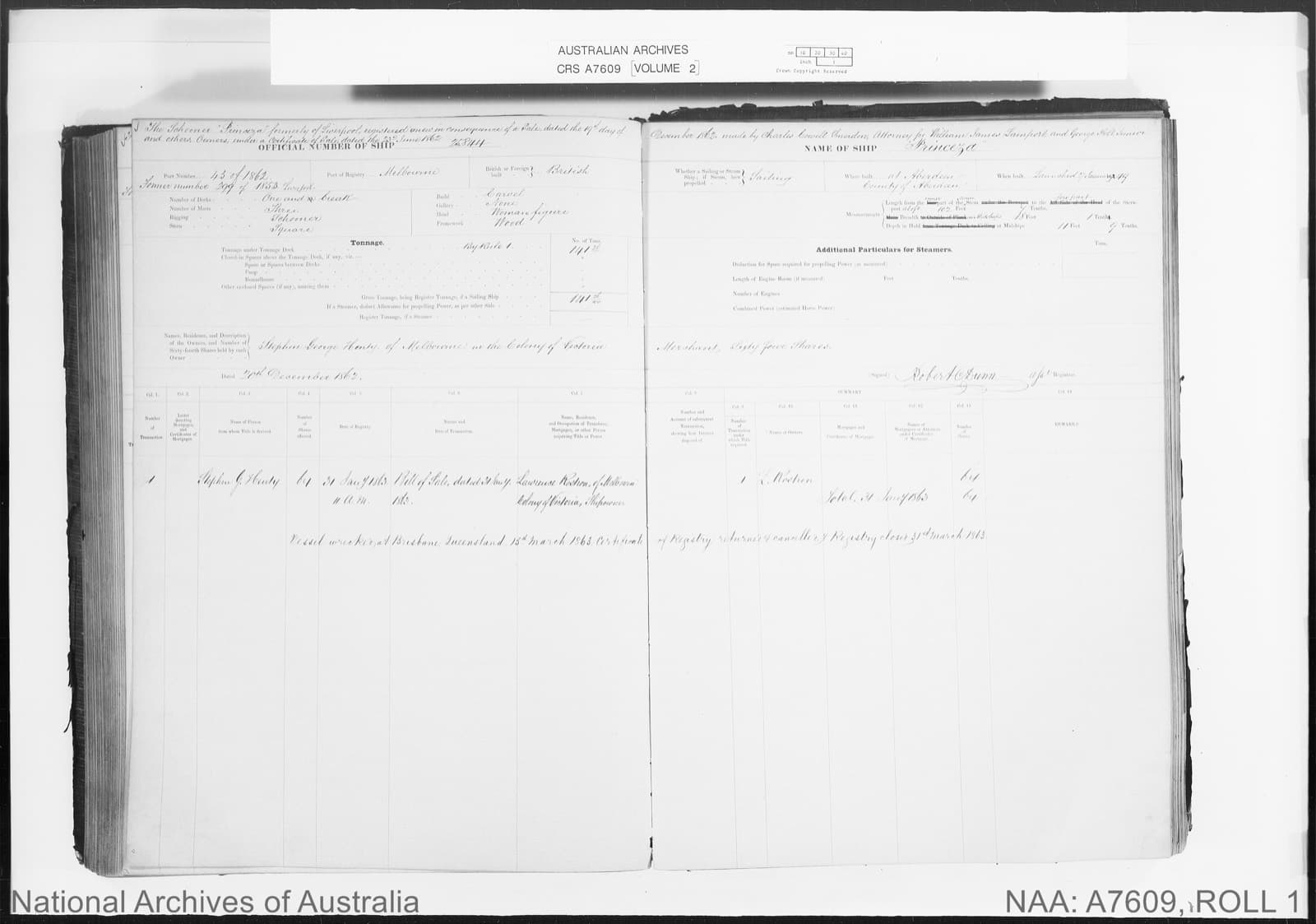
The best record of what the Princeza was is the page the Melbourne registrar opened for her on 20 December 1862, which survives in the National Archives of Australia[1].
| Field | Value (Melbourne register, 20 December 1862) |
|---|---|
| Name | Princeza, "formerly of Liverpool" |
| Official number | 25844 |
| Former number | 299 of 1853, Liverpool |
| Port number | 45 of 1862, Melbourne |
| Where and when built | Aberdeen, launched January 1849 |
| Masts | Three |
| Rig | Schooner |
| Stern | Square |
| Build | Carvel (planks laid edge to edge, for a smooth hull) |
| Head | A woman figurehead |
| Framework | Wood |
| Decks | One, and a break |
| Length | 102 ft 7 tenths |
| Breadth | 18 ft 1 tenth |
| Depth of hold | 11 ft 9 tenths |
| Tonnage | 141 26/100 tons |
| Owner | Stephen George Henty, of Melbourne, merchant, 64 shares |
She was Aberdeen-built, in 1849. Alexander Hall & Co. of Footdee, Aberdeen, built her as yard number 169 and launched her in January 1849[2][1]. Hall's builder's list, kept at the Aberdeen Maritime Museum, puts her cost at £2,081[2]. The Brisbane paper that reported the wreck said she was built in 1850[9]. The register and the yard's own records agree on 1849, and that year is used here.
She started life as a brig and ended it with three masts. Aberdeen's records describe her as a brig, a two-masted ship with square sails on both masts[2]. By the time she reached Adelaide in October 1861 the shipping columns were calling her a "three-masted schooner"[5], the Melbourne register of 1862 says the same[1], and the Brisbane Courier called her "a three-masted brigantine"[9]. Lloyd's Register dates the change: she is a brig in every edition to 1855 and a schooner from 1856, the edition that also records repairs in 1855[4]. The Australasian Underwater Cultural Heritage Database (AUCHD) lists her as a brigantine with three masts, which is a contradiction in terms[17]. Three-masted schooner is her registered rig, and the one used here.
The tonnages do not agree, and the gap is explicable. The register gives 141 26/100 tons, and every Australian shipping column from 1861 to 1863 rounds that to 141[1][9]. Aberdeen's record gives 149 gross tons[2], and the Melbourne sale lists of December 1862 also called her "149 tons register"[7]. Register tonnage is a measure of the enclosed space in a hull, not its weight, and the rules for measuring it changed with the Merchant Shipping Act 1854. The 149 is her 1849 measurement, which Lloyd's never updated; the Board of Trade's Mercantile Navy List already had her at 141 by 1860, while she was still a Liverpool ship[22]. The figure used here is the one on her last certificate: 141 tons.
What she was like. The one description of her by someone trying to sell her is James Lawrance's advertisement of December 1862: "copper-fastened and sheathed with Muntz's Metal", of "light draught of water", able to stand without ballast, with a complete inventory and "very handsome" cabin accommodation[26]. Light draught and little ballast fit a coasting trader, and they may also explain Captain Sayers's complaint that, being "a long vessel", she was slow to turn when the bar came up under her[9].
Her previous owners were Lamport & Holt of Liverpool. The register records that she was "registered anew in consequence of a sale dated the 19th day of December 1862, made by Charles Lowell Smerdon, attorney for William James Lamport and George Holt junior and others, owners, under a certificate of sale dated the 23rd June 1862"[1]. Aberdeen's record lists her owners from 1854 only as "Lamport & Co."[2], and Lloyd's prints a truncated "L'mport &"[4]. The register names them: William James Lamport and George Holt, the founders of the Liverpool shipping firm Lamport & Holt. Smerdon, who signed the sale on their behalf, was her master[5].
She changed hands twice in six weeks, and the prices are on record. The Melbourne ship-broker James Lawrance sold her in December 1862 as "schooner Princeza, 149 tons register, 240 tons burthen" for £1,675[7], and Stephen George Henty of Melbourne, the Portland merchant and shipowner, was entered as sole owner on 20 December[1]. In February Lawrance sold her again at Lloyd's rooms, "the schooner Princeza, 150 tons register, for £1,700"[8]; the register records the bill of sale of all 64 shares from Henty to Lawrence Rostron of Melbourne, shipowner, on 31 January 1863[1]. Six weeks after that she was a wreck, and the wreck fetched £160. The register's last line reads: "Vessel wrecked at Brisbane Queensland 15th March 1863. Certificate of Registry returned & cancelled & Registry closed 31st March 1863"[1].
A conflict worth flagging: who owned her when she was lost. The register says Rostron. The Courier of 18 March 1863 said "She is owned by Messrs. B. B. Nicholson and Co., of Melbourne"[9], and the paper's own fifty-years-ago column in 1913 repeated it as "W. B. Nicholson and Co."[30]. The register is the legal record and is the better authority on ownership. Nicholson and Co. may have been her charterers or agents for the Brisbane voyage, or Rostron may have been holding her for them; the sources consulted do not say. Both names are given here and neither is asserted as the whole truth.
Liverpool, Mexico and Natal
For her first thirteen years the Princeza was a British ship, and the British registers follow her year by year. Lloyd's Register, the annual classification list kept by the London insurers, carries her in every edition from 1849 to 1866, and the Lloyd's Register Foundation has put its own annotated working copies online, so the entries can be read as the surveyors left them[3].
1849–1853: Miller & Thomson, and Mexico. The first edition to list her, for 1849, has "Princeza, brig, W. Boase, 149 tons, built Aberdeen 1849, owners Miller & Co., port Liverpool, surveyed at Aberdeen, class A1"[3]. Aberdeen's record expands the owners to Miller & Thomson of Liverpool[2]. From the 1850 edition her voyage column reads "Liverpool–Mexico", and it stays so until 1853[3]. Who Miller & Thomson were, and why a Liverpool firm gave an Aberdeen brig a Portuguese name meaning "princess", nothing consulted explains.
1853–1862: Lamport & Holt, and the Natal trade. The Liverpool registry re-entered her on 5 July 1853 as number 299 of that year, and the 1854 edition of Lloyd's prints a new owner, "Lamport &", a new master, P. Johnson, and a new run, "Liverpool–Port Natal"[16][4]. Lamport & Holt, founded in Liverpool in 1845 by William James Lamport and George Holt junior, were then still a sailing-ship firm, and the Princeza spent six years carrying their trade to Port Natal, now Durban: from Liverpool under Johnson in 1854–55, from Workington in Cumberland under a master named Gordon in 1856–57, and from Liverpool again under Lee in 1858–59[4][2].
1855: two masts become three. The 1855 edition still calls her a brig. The 1856 edition calls her a schooner, and the same line records "damages repaired and some repairs, 1855"[4]. That is the moment she was re-rigged: a two-masted square-rigger became a three-masted schooner, fore-and-aft rigged, which needs fewer hands. Lloyd's had no separate code for a three-masted schooner, so "Sr" is all it ever printed; the Adelaide and Melbourne shipping reporters, who saw her, wrote "three-masted schooner"[5][6], and the Brisbane press, which did not, wrote "three-masted brigantine"[9].
1860: a special survey, a new master, a new tonnage. The 1860 edition records a special survey in London that renewed her A1 class for four years, with further repairs, and prints a new master, "C. Smerdon"[21]. The Mercantile Navy List for the same year, the Board of Trade's annual list of British-registered ships, gives her the signal letters PHQV and a tonnage of 141, not 149[22]: she had been re-measured under the rules of the Merchant Shipping Act 1854, and that is the figure every Australian port afterwards used.
1861–1862: out to the Indian Ocean. Under Smerdon she left Liverpool in 1861 and did not come back. By October of that year she was at Adelaide with sugar from Mauritius[5]. Lamport & Holt's certificate of sale is dated 23 June 1862, and in the firm's working copy of the 1862–63 Lloyd's the owner's name is struck through by hand[1][42].
The British record never caught up. Lloyd's went on printing her, owner blank, to its 1866–67 edition[34]. The Mercantile Navy List of 1865 shows her registered at Melbourne to Stephen G. Henty, and the list of 1869 to Lawrence Rostron, both of whom had sold or lost her years before[33][35]. Only on 12 May 1869 did the Registrar General of Shipping in London note against her official number "Lost per advice", and she is gone from the 1870 list[16]. The Melbourne registry had closed her file on 31 March 1863[1]. Aberdeen's museum notes, correctly, that she "continues to be in Lloyd's some years after her loss"[2]; the reason is that nobody told London for six years.
Sugar from Mauritius
The Princeza came to Australia by way of the Indian Ocean sugar trade, and the shipping columns of Adelaide and Melbourne record her two visits.
Adelaide, October 1861. She arrived off Port Adelaide on the evening of Monday 28 October 1861, thirty-three days out from Port Louis, Mauritius, with a full cargo of sugar: 2,289 bags, 347,734 pounds of it, for the merchant J. Darwent[5][43]. The South Australian Register described her as "a fine three-masted schooner" and printed Captain Smerdon's account of the passage: strong gales throughout, and in the Southern Ocean a heavy sea that "stove in the bulwarks on both sides" and shifted the cargo[23]. The sugar was auctioned at the Mart on 5 November "at what we believe were remunerative rates"[44][45]. She was advertised to load for Mauritius, "calling at King George's Sound if inducement offers"[46], cleared the customs on 21 November with flour, pollard, bran, wheat, hay and leather, and sailed on the 23rd for Port Louis[24][25].
A note on "Guam". The Adelaide clearance columns of that week have her, and several other ships bound elsewhere, cleared "for Guam"[24]. Aberdeen's museum record copied the line and glossed it "[Pacific Islands]"[2]. It was a customs house formula for a vessel clearing without a fixed destination; the same column lists her "For Mauritius, early", and the sailing list says Port Louis[24][25]. She never went near Guam.
Where she was in 1862. Between leaving Adelaide in November 1861 and reaching Melbourne in December 1862 the Australian papers lose her. Lamport & Holt's certificate of sale is dated 23 June 1862, so by then her owners in Liverpool had decided to be rid of her[1]. Where she was that day, and what she did in the intervening year, would need the Mauritius press to settle; see Gaps and uncertainties.
Melbourne, December 1862. She passed Port Phillip Heads on 9 December 1862, forty-one days from Port Louis, "three-masted schooner, 141 tons, C. Smerdon", with 2,372 bags of sugar to order and R. and P. Turnbull and Co. as agents[6]. She also carried news. Captain Smerdon gave the Melbourne papers a report of the hurricane that had struck the Seychelles on 12 October, two days of wind and rain that swept away villages, destroyed the coconut trees and left eighty dead in the mud, and his account went round the colonial press[6]. Her sugar was sold by auction in nine estate lots at Fraser and Cohen's rooms on 16 December[47].
For sale. Before the sugar was off her, the ship-broker James Lawrance had her up for auction at Lloyd's Rooms, Melbourne, on 22 December[26]:
The fine Aberdeen clipper three-masted schooner PRINCEZA. 149 tons register, 240 tons burden, copper-fastened and sheathed with Muntz's Metal. This beautiful vessel is now to be seen at the Wharf, near the New Dock, discharging her cargo of sugar from the Mauritius, where intending purchasers are respectfully invited to inspect her. She will be found to be well adapted for a general coasting trade, having light draught of water, stands without ballast, and requires very little to go to sea with. Her inventory is most complete in every respect, besides having six months' provisions on board. Her cabin accommodation is very handsome, and complete with every convenience[26].
She did not reach the auction. The register's sale is dated 19 December, three days before it[1], and Lawrance's list of the month's sales gives the result: "schooner Princeza, 149 tons register, 240 tons burthen, £1,675"[7]. Her new owner, Stephen George Henty, sent her on two short trips to his home port of Portland in January 1863[27][28], then sold her again, for £1,700, to Lawrence Rostron[8][1].
Three owners in three months
The Princeza's last Australian owners were all Melbourne men, and the paper trail on them is uneven.
Lamport & Holt sold her. William James Lamport and George Holt founded their Liverpool shipping firm in 1845, and the Princeza's Liverpool years from 1854 were spent under their flag, trading to Port Natal[2]. Their attorney in Melbourne was her own master, Charles Lowell Smerdon, who had brought her out from Mauritius with sugar in December 1862[6]. He signed the sale on their behalf on 19 December[1].
Stephen George Henty bought her. Henty (1811–1872) was the Portland merchant whose family had founded the first permanent settlement in what became Victoria. The Australian Dictionary of Biography describes him as merchant, trader, shipowner, whaler and magistrate, and a member of the Victorian Legislative Council from 1856 to 1870, living for most of those years at Findon, his Melbourne mansion[48]. He paid £1,675 for the Princeza[7] and held her for six weeks, during which she made one voyage to his home port of Portland[27]. His Portland partnership with William Learmonth, Henty, Learmonth and Co., ended in 1863[49]. The earlier version of this page claimed that the sale of the Princeza was "almost certainly" part of a wind-down of Henty's shipping before that partnership was dissolved. No source supports the link, and it is not asserted here.
Lawrence Rostron bought her from Henty. The register calls him "of Melbourne, shipowner"[1], and the Argus recorded the February sale at £1,700[8]. Beyond that he is a name. Two Lawrence Rostrons lived in Victoria in 1863, a Lancashire-born pastoralist of Tottington station (1800–1877) and a younger namesake (1838–1916), and nothing consulted says which of them, if either, bought ships. The question is left open in Gaps and uncertainties.
"B. B. Nicholson and Co." were her agents, not her owners. The Courier said the Princeza "is owned by Messrs. B. B. Nicholson and Co., of Melbourne"[9], and the type is clear on the page. The Melbourne customs column settles what the firm was. When she cleared out on 5 February 1863 the Argus printed "Princeza, schooner, 141 tons, A. Sayers, for River Mersey, V.D.L. B. B. Nicholson and Co., agents"[10]; the same firm appears as agents for other vessels in the same columns[8]. The Brisbane reporter, or the captain, turned her clearing agents into her owners, and the paper's own fifty-years-ago column made it "W. B."[30]. The register's Rostron stands. (The "H. Nicholson" in a Melbourne sugar advertisement that month is the barque Hannah Nicholson, not a merchant[50][51].)
George Raff and Co. were waiting for the cargo. The hay, oats, wheat, potatoes and timber were consigned to George Raff and Co. of Brisbane[9]. Raff (1815–1889), a Scot who had set up as a merchant in Brisbane in 1851, was by 1863 a director of the Queensland Steam Navigation Company and the member for Brisbane in the colony's first parliament[52].
Captain Sayers. The Brisbane papers never gave his first name; the Melbourne clearance and the Geelong Advertiser call him "A. Sayers"[10][53]. An Augustus Sayers was master of the schooner Natal of Geelong, 178 tons, from Melbourne to Sydney in December 1863, nine months after the wreck[54], and an "A. Sayers" had commanded the small steamer Emu of Melbourne in 1859[55]. He may well be the same man. The earlier version of this page called him John; no source gives that name.
The last voyage
The Princeza's last voyage began in Melbourne in February 1863. She was entered outwards at the customs house on 3 February, "Princeza, brig, 141 tons, — Sayers, for River Mersey, V.D.L."[29], cleared out on the 5th with her Melbourne cargo, 110 cases of geneva (Dutch gin), three kegs of tobacco, fifty cases of lobsters, 500 bushels of bran and 33,000 feet of sawn timber[10], and passed the Heads on Tuesday 10 February[11]. Van Diemen's Land had been Tasmania since 1856, but the Melbourne shipping columns had not caught up. The Courier's later "about the 14th February" is a few days out[9].
Her purpose there was to finish loading. Captain Sayers's own account, printed in the Courier three days after the wreck, says she left Melbourne "for Port Frederick, in Tasmania, for the purpose of completing her cargo", and sailed from there for Brisbane on 28 February[9]. No Tasmanian paper that survives on Trove noticed her at the Mersey. Port Frederick was the bay on the western bank of the Mersey, in the settlement then called Formby; it had its own Marine Board from 1860, and a sandbar at the river mouth that limited the size of vessel that could enter[56]. Formby and Torquay, the township across the river, were later joined as Devonport[57]. By the time she sailed north the cargo was farm produce for the Brisbane market, hay, oats, wheat, potatoes and timber, on top of the gin and tinned lobsters from Melbourne, all of it consigned to George Raff and Co., Brisbane merchants[9][10]. The Courier believed that both ship and cargo were insured[9].
The passage north was slow. She had light and changeable winds as far as Port Stephens, north of Newcastle, and then strong north-easterly gales, dead against her, until Friday 13 March, when the wind swung into the south-east and let her run for Moreton Bay[9].
Brisbane was expecting her. On 28 February the Courier had corrected an earlier report of a vessel loading for the port: "We have since learnt that the vessel is called the Princeza"[58].
The bar
Moreton Bay has two entrances. The northern one, past Cape Moreton, is the deep one, and by 1863 it was the way in: the pilot station was on Moreton Island[14]. The southern one, the South Passage between Moreton Island and North Stradbroke Island, is a bar of sand that moves. It had been the main entrance until the paddle steamer Sovereign broke up on it in March 1847 with the loss of forty-four lives[59]. The Amity Point pilot station was closed after that, in 1848 by the usual account[60], or in 1858, when the Cape Moreton light was lit, by the recollection of the Brisbane historian Thomas Welsby[61]. Either way, by 1863 the pilot station was on Moreton Island, at the other end of the bay[14]. The Princeza's captain did not know this, and the Courier afterwards blamed "a want of proper charts"[13].
On Sunday morning, 15 March, she rounded Point Lookout, and Captain Sayers "signalled for a pilot, under the impression that a pilot station was close at hand"[9]. When none came he took her in himself, with little sail set, steering for the entrance as his chart showed it and checking the depth as he went with a weighted line. The water went from five fathoms to three, about nine metres to five and a half, "suddenly". He tried to turn her round and away from the bank, but, in his words, "being a long vessel she would not pay off readily, and shortly afterwards she struck"[9].
The first grounding did very little damage, and Sayers thought she would probably have been got off. But the tide was turning, and "at this critical time a heavy sea rose", too heavy to lower a boat and carry an anchor out to pull her off. She shifted several times during the day, but so close to the bottom she would not steer, and the crew could not work her clear[9].
Cutting away the masts
At six o'clock on Sunday evening the captain began lightening her, throwing the cargo overboard. She kept bumping over the bank, so he ordered the masts cut away to ease her further. "The sea at this time was washing fore and aft the wreck"[9]: it was breaking right over her, from bow to stern.
The boat
After a time the sea eased enough to launch a boat. It swamped at once. The crew bailed it out, but it was too small to carry everyone, so Captain Sayers and two seamen who volunteered to stay with him remained on the wreck while the others were taken ashore. The boat then came back for the three men. When the tide turned again the water smoothed, and the crew were able to get back aboard and save some of their clothes and belongings[9].
Nobody died. On Tuesday 17 March the captain and crew were brought up to Brisbane "in a boat belonging to a fisherman named Med", and Sayers gave his account to the Courier that day[9]. The paper does not say how many men were in the crew, and none of them but the captain is named in any account consulted. "When they left the vessel she was lying, bilged, on the beach at Amity Point"[9]. Bilged means her hull had been broken open. The Courier thought that "if energetic measures be taken a considerable portion of her cargo may be recovered, though in a damaged state"[9].
Sold for £160
Energetic measures were taken the next morning. The same issue of the Courier that carried Sayers's account carried the auctioneer Arthur Martin's advertisement: "Wreck of the Princessa ... THIS DAY, AT 12 O'CLOCK ... The three-masted Brigantine PRINCESSA, as she lies stranded off Amity Point. Together with her Anchors, Chains, &c., &c. Also, The CARGO"[31]. So on Wednesday 18 March, three days after she struck and one day after her captain reached town, the wreck went under the hammer at the City Auction Mart at the corner of Queen and Edward streets, and sold for £160[12][13].
The Courier's commercial column explained the price. The vessel and her cargo had been valued at £3,000. There was "a large attendance and some competition" at the sale, but "the risky nature of the speculation", the difficulty of reaching the wreck and getting the timber off, stopped the bidding at £160, "and Messrs. Muir, Low, and two others were declared the purchasers"[13]. Who the two others were, no paper says. The same column gave the only verdict on the loss that Brisbane ever delivered. There was no inquiry. "If we are correctly informed a want of proper charts has led to this disaster. We should be wanting in our duty to the port did we not state that the Northern entrance is perfectly safe with proper charts and sailing directions"[13]. The same day the Government Customs boat went down the river under Inspector McDonald, with a party to take charge of the bonded goods, the spirits on which duty had not been paid, still aboard the wreck[12].
The buyers were two Brisbane men, Andrew Muir and James Low junior. They wasted no time in warning off anyone else with an eye on her. A notice dated 18 March appeared in both Brisbane papers on the 21st:
NOTICE is hereby given that any Person or Persons interfering with the HULL or CARGO of the Brigantine PRINCEZA, lately wreck[ed] at Amity Point, Stradbroke Island, will be prosecuted to the utmost rigor of the law. ANDREW MUIR. JAMES LOW, Jun. Brisbane, March 18, 1863[32].
A conflict worth flagging: Muir's first name. The Guardian's report of the auction called the buyers "Messrs. Alexander Muir and James Low"[12], and the AUCHD record repeats "Alexander"[17]. The notice that Muir himself signed, printed in both papers, says Andrew[32]. A man's own signed notice is the better evidence, and he is Andrew Muir here. The pair were in the business. The Courier's weekly summary noted that Low and Muir, "it will be remembered, also purchased the wreck of the Friends a few weeks ago"[62]; buying wrecks for what could be stripped from them was a trade, and a Mr Low's schooner, the Granite City, was in the timber trade that April[63].
The Lady Bowen
On Thursday 19 March Muir and Low left Brisbane for the wreck in a small yacht, the Lady Bowen, to see what could be saved[14]. They reached Amity Point early the next morning and found that the current and the heavy sea running in on the shore had rolled the Princeza over. She was floating bottom up, with her sides torn away[14][15].
The hull was afloat, so they tried to tow it into a more sheltered part of the bay. Then the weather turned. The gale of Friday 20 March was one of the worst Moreton Bay had seen. At the pilot station on Moreton Island trees were torn up, a heavy whaleboat was blown "over and over along the beach" and the pilots' boat-house was partly unroofed; the Courier added that the lighthouse keepers had refused to stay in the lantern that night for fear the tower would go over[14]. The superintendent at Cape Moreton, James Brayden, wrote in to deny it: his keepers had stood their watches as usual, though "there is no doubt the tower did oscillate a good deal" in what he called the most severe gale he had ever seen, the sea "literally one sheet of foam"[64]. Muir and Low had to let the wreck go and run up the bay for shelter. The abandoned hull drifted across the entrance and went ashore on Moreton Island, "between the outer and inner heads of the South entrance, where she now lies bottom upward"[14]. The Guardian put it "near the Heads at the south entrance of the bay"[15].
The Lady Bowen did not get away either. During the night of the 20th she dragged her anchors and went ashore, and the Guardian reported her "totally lost"[15][14]. She was a 12-ton cutter built at Rockhampton in 1860, and she has her own record in the AUCHD, which places her loss near Amity Point and notes that she may later have been refloated[65]. The same gale wrecked the cutter Schnapper, which was towing a raft of pine up to Brisbane at the river mouth, and two whaleboats; the raft broke up and the timber was last seen going out to sea through the South Passage[14][15]. Sixty or seventy of its pine logs came ashore on the beach at Cape Moreton[64]. No lives were lost in any of it[14].
What the buyers got for their £160 was less than they hoped. Almost the whole of the cargo was lost, apart from a quantity of sawn timber. Of the cases of gin aboard only nine had been found, and the Customs took charge of those at once "to prevent loss to the revenue"[14]. By the end of the month the Customs boat was still working at the wreck[66]. The rigging lay strewn along the beach, and all the gear belonging to the foremast had been recovered[15]. The owners still believed that "from the position of the hulk, a considerable amount of valuable property may be saved"[14].
In Melbourne the registrar closed her file on 31 March[1].
The wreck today
Nobody has found the Princeza, and nobody has looked.
What the record holds. The Australasian Underwater Cultural Heritage Database (AUCHD), the national register of historic wrecks, gives her a position of -27.3817, 153.43, with the derivation "Historical reference"[17]. That is a desk estimate made from the 1863 reports, not a measured fix. The Queensland Heritage Branch, which keeps the state's entries in that database, plotted the same point on its 2014 map of Moreton Bay's shipwrecks with the red "estimate" symbol, in the middle of the South Passage between Amity Point and the southern tip of Moreton Island, and put the Lady Bowen on the same symbol[18]. Of the nine wrecks in the map's South Passage inset, only the Rufus King gets the green symbol for an exact position[18]. Every field in the record that would describe the site, its depth, its condition, its surveys, is empty[17]. The Queensland Government says reliable data exist for fewer than 12 per cent of the known wreck sites on its coast[67].
Where she probably lies. The contemporary record is clearer than the database. She struck on the bar off Amity Point, on the Stradbroke side[9]. Five days later her hull, rolled over and stripped of its sides, drifted across the entrance and went ashore "on Moreton Island, between the outer and inner heads of the South entrance"[14]. The 1848 Admiralty chart names no "heads", but the reading that fits is the passage-facing beach at the southern tip of Moreton Island, between the ocean-side point where the North Bar begins and Sandy Point on the bay side: the same beach that took the Sovereign in 1847[68][59]. That is an interpretation of the Courier's wording, not something any source states outright. A Rockhampton columnist in 1928 remembered her as lost "near where the Sovereign was lost"[37]. No report of her timbers, her copper or her gear being seen after April 1863 has been found.
The sand has moved. A wooden hull of 1849 that lay on an exposed bar and then an ocean beach would not have lasted many seasons, and the ground it lay on has not stayed still. The colony's own Ports and Harbours department wrote in 1891 that approach by the South Passage "should be discouraged, as the banks move about in a remarkable manner"[19]. If anything of her is left, it is under the sand of the passage or the southern beach of Moreton Island, and the AUCHD point is best read as marking the passage, not a wreck.
Protection and access
The Acts. The Underwater Cultural Heritage Act 2018 (Commonwealth) protects all remains of vessels that have been in Australian waters for at least 75 years, without any need for a declaration, and makes it an offence to disturb or remove them without a permit[20]. The AUCHD lists the Princeza as protected under that Act, with no protected zone around her[17][69]. Before 2019 she was covered by the Historic Shipwrecks Act 1976 through the blanket declaration for Queensland waters of November 1977[39][40]. The recorded position sits in the Queensland cadastral water parcel named "Moreton Bay", so the state's own Queensland Heritage Act 1992, which treats a wreck of 75 years' standing in Queensland waters as a historic shipwreck, applies as well[70][71]. The Queensland Heritage Branch administers the program for the state and is the office to tell if anything is found; its written consent is needed to disturb a wreck or recover an artefact[72][67].
The registers. AUCHD Shipwreck ID 3024[17]. Queensland Heritage Branch, Moreton Bay Shipwrecks map (2014), South Passage inset, "estimate"[18]. She is not on the Queensland Heritage Register. Her sister record is AUCHD 2737, the Lady Bowen[65].
The marine park. Both the AUCHD point and the Lady Bowen's fall in zone CPZ07, "South Passage–Boat Rock", a Conservation Park Zone of the Moreton Bay Marine Park under the 2019 zoning plan, where limited line fishing, spearfishing and trolling are allowed[71][73]. Neither point is inside a national park; the parks on both islands stop at the shore[71].
Country. The South Passage is Quandamooka sea country. The Federal Court's 2011 determination recognised the native title of the Quandamooka People, the Nunukul, Ngugi and Goenpul, over North Stradbroke Island and the surrounding waters, including the passage[41]. In 1863 Amity Point was home to a community of Aboriginal people and a handful of resident fishermen; a Brisbane historian who knew the place later wrote that in 1853 there were "upwards of 150 natives living at the Point"[74]. The fisherman who carried the Princeza's crew to Brisbane came from that community, though nothing but his name, as the Courier printed it, is recorded[9].
What the record gets wrong
For a wreck with no survivors' inquiry and no site, the Princeza is reasonably well documented, and the compiled records have still managed to disagree with the primary ones on most points. Each is correctable.
| Claim | Where it appears | What the evidence says |
|---|---|---|
| Built at Aberdeen in 1850 | The Courier, 18 March 1863, and every reprint; the earlier version of this page | Launched January 1849: the Melbourne register and Hall's yard record agree[1][2]. The AUCHD has 1849[17]. |
| A brigantine | The Brisbane press; the AUCHD rig field | The AUCHD's own construction field says three masts, which a brigantine cannot have[17]. The register says three-masted schooner[1]; Aberdeen says she was launched a brig[2]. |
| Gross 141 tons, register 149 | AUCHD | Both figures are register tonnages under different measuring rules: 149 at Liverpool in 1853, 141 26/100 at Melbourne in 1862[75][1]. |
| Bought by "Alexander Muir" | The Guardian, 19 March 1863; the AUCHD; the earlier version of this page and the website | He signed his notice "Andrew Muir" on the day of the auction[32][12]. |
| Owner "B. R. Nicholson & Co" | AUCHD | The Courier printed "B. B. Nicholson and Co."[9]; the 1913 column "W. B."[30]; the register says Lawrence Rostron[1]. |
| Melbourne port number 15 of 1862 | AUCHD | The register page reads 45 of 1862[1]. |
| Port of origin "Port Fredrick" | AUCHD | Port Frederick, River Mersey[9][56]. |
| "No location data available" | The AUCHD map panel | The record's Location tab holds -27.3817, 153.43, "Historical reference"[17]; the map widget does not draw it. |
| Salvaged with "the steamer Lady Bowen" | The earlier version of this page | A "pretty little yacht", a 12-ton cutter[14][65]. |
| Captain "John" Sayers | The earlier version of this page | No source gives a first name beyond the Geelong Advertiser's "A."[53]. |
| Wrecked 4 March 1847 (the Sovereign) and "two wrecks" only in the Rous Channel | "Junius", 1929 | The Sovereign was lost on 11 March 1847[59]; the Lady Bowen, lost in the same gale as the Princeza, makes a third[15]. |
Two further points are not errors but genuine ambiguities, and both are left open: who owned her at the loss (Rostron on paper, Nicholson in the press), and when the Amity Point pilot station closed (1848 in the usual account, 1858 by the recollection of Thomas Welsby, who said it went when the Cape Moreton light was lit)[60][61].
Gaps and uncertainties
Things this page could not establish, and where they would be found.
- The crew. No account gives their number or a single name besides the captain's. The crew agreement signed at Melbourne in February 1863 is the record that would: Public Record Office Victoria, VPRS 566, Articles of Agreement, Mercantile Marine Office, Melbourne.
- Captain Sayers's first name. Only the initial A. is printed[10][53]. An Augustus Sayers was master of the Natal of Geelong nine months later[54], and the same crew agreement would confirm whether he is the man. The 2025 version of this page called him John, on no authority.
- Who bought the wreck. The buyer signed himself Andrew Muir[32]; the Guardian's reporter wrote Alexander[12]; the Courier adds "two others" it does not name[13]. A Mr Low owned the timber schooner Granite City and a David Muir was the government shipwright that year[63]; whether either is our man is unproven. Pugh's Almanac for 1863–65 and the Queensland Post Office Directory would settle the names; Queensland State Archives' Customs records would show what became of the gin.
- Lawrence Rostron. The register's buyer of 31 January 1863, "of Melbourne, shipowner"[1], has not been identified with confidence. Two men of the name lived in Victoria: the Lancashire-born pastoralist of Tottington (1800–1877) and a namesake born in 1838. Victorian probate files and the 1863 Melbourne directories would say which, if either, bought ships.
- Where she was in 1862. Nothing has been found between her sailing from Adelaide for Mauritius on 23 November 1861 and her arrival at Melbourne on 9 December 1862, a year in which her Liverpool owners sold her (certificate of sale, 23 June 1862)[1]. The Port Louis Commercial Gazette of 1862, if any file survives, would fill it.
- Miller & Thomson, and the name. Her first owners (1849–53) and the reason an Aberdeen brig carried the Portuguese word for "princess" are unexplained. The Liverpool ship registers of 1849 and 1853 (Merseyside Maritime Museum; The National Archives (UK), BT 108) name the owners and their shares; the Aberdeen Journal of January 1849 (British Newspaper Archive, not consulted) may have the launch.
- Where the hull came to rest. The Courier says Moreton Island, between the heads of the South entrance[14]; the AUCHD point is a mid-passage estimate[17]. No survey or sighting since 1863 has been found. The Queensland Museum's maritime archaeology files (the Lady Bowen's record cites file 863/20) and Paterson's Wreck-ollections vol. 1, p. 132, which the AUCHD follows but which was not available to read, might hold more.
- The reference books. Paterson (2003), Loney (1982, 1993) and Stone (2006) were not consulted; none is online. Their entries should be checked against this page at the State Library of Queensland.
- The pilot station. Whether Amity Point lost its pilots in 1848 or 1858[60][61]. The Queensland Blue Books for 1860–63, or the New South Wales ones before separation, list the pilot establishment year by year.
- The British registers after 1863. The Mercantile Navy Lists for 1864 and 1866–68 were not reachable in open full view; those seen (1865, 1869) show London still listing her to owners who had sold her[33][35]. The closed registry transcript would be in BT 110 at The National Archives (UK).
- Searches not run. Trove's own search returns nothing for "Princeza" after 1869 because the later OCR mangles the name; the 1920s items here were found by searching "Amity" and "Smerdon", and more may be hiding. The British Newspaper Archive, HathiTrust and the Natal newspapers of the 1850s were behind walls or unreachable and were not searched. Google Books' search inside Heaton (1879) and the Lloyd's Register volumes for 1864–65 could not be read.
News stories from history
The Courier, 18 March 1863 - Captain Sayers's account
The whole of the Brisbane report, the source of every reprint in the colonies, was furnished by the captain the day after he reached town[9].
The brigantine Princeza was totally wrecked while attempting to enter the South Entrance to Moreton Bay on Sunday, the 15th instant. She is a three-masted brigantine of 141 tons; and, at the time of the disaster, was under the command of Captain Sayers. She was built at Aberdeen, in the year 1850, and has been but a short period in the intercolonial trade. She is owned by Messrs. B. B. Nicholson and Co., of Melbourne. We believe that both vessel and cargo were insured. The cargo consisted of hay, oats, wheat, potatoes, timber, and small quantities of spirits and preserved provisions, the whole of which was consigned to Messrs. G. Raff and Co., of this city. The following particulars of the wreck were kindly furnished to us by Captain Sayers yesterday:—
The brigantine Princeza, Captain Sayers, bound for Moreton Bay, left Melbourne about the 14th February, for Port Frederick, in Tasmania, for the purpose of completing her cargo. Having done so, she sailed for this port on the 28th February. She experienced light variable winds until off Port Stephens, after which she met with strong N.E. gales until Friday the 13th instant, when the wind shifted round to the S.E. She rounded Point Lookout on Sunday morning, when the captain signalled for a pilot, under the impression that a pilot station was close at hand. He then shaped his course under easy sail for the entrance, as marked on the chart, feeling his way with the lead, when suddenly the water shoaled from five to three fathoms. He then tried to wear ship, but being a long vessel she would not pay off readily, and shortly afterwards she struck. Very little damage was done by the first grounding, and probably she would have been got off safely, but that owing to the turning of the tide, at this critical time a heavy sea rose, which prevented the lowering of a boat to get out an anchor. The vessel moved several times during the day, but on account of her being so near the ground she would not answer her helm, and the crew were, therefore, unable to get her out of her perilous position. At 6 o'clock on Sunday evening, the captain commenced lightening the vessel by throwing cargo overboard; and as she still kept bumping over the bank he ordered the masts to be cut away to still further ease her. The sea at this time was washing fore and aft the wreck. After a time the sea abated, when a boat was launched but swamped immediately. The crew, however, succeeded in freeing her of water. The boat was inadequate to carrying the whole crew, so the captain and two seamen who volunteered to stay with him, remained on the wreck, while the others were taken ashore. When this was effected, the boat returned for those left on the wreck. After the tide turned the water became smoother and the crew were thus enabled to return to the wreck and secure a portion of their clothes and effects. The Captain and crew were brought up to town yesterday in a boat belonging to a fisherman named Med. When they left the vessel she was lying, bilged, on the beach at Amity Point. It is believed that if energetic measures be taken a considerable portion of her cargo may be recovered, though in a damaged state.
By an advertisement in our issue this morning it will be seen that the vessel and cargo are to be sold.
The advertisement, on the front page of the same issue[31]:
THIS DAY, AT 12 O'CLOCK. Wreck of the Princessa. ARTHUR MARTIN will sell by auction, at the City Auction Mart, Queen and Edward streets, on WEDNESDAY, March 18th, at 12 o'clock, The three-masted Brigantine PRINCESSA, as she lies stranded off Amity Point. Together with her Anchors, Chains, &c., &c. Also, The CARGO. Particulars of which may be seen at the office of the auctioneer.
The Guardian, 19 March 1863 - sold at auction
From the shipping column of Brisbane's other paper[12].
The wreck of the brigantine Princeza, was yesterday purchased for £160, by Messrs. Alexander Muir and James Low, at Mr. A. Martin's auction.
The Government Customs boat, in charge of Inspector McDonald, went down the river yesterday with a party to take charge of the bonded goods on board the wreck Princeza.
(The buyer signed himself Andrew, not Alexander, three days later; see Sold for £160.)
The Courier, 20 March 1863 - the price, and the verdict
From the commercial column, the nearest thing to a finding the loss ever got[13].
In the case of the Princeza, her loss and the subsequent sale of the wreck and cargo followed each other so quickly as scarcely to allow time to chronicle the events separately. If we are correctly informed a want of proper charts has led to this disaster. We should be wanting in our duty to the port did we not state that the Northern entrance is perfectly safe with proper charts and sailing directions. We are credibly informed that the vessel and her cargo were valued at £3000. At the sale of the wreck, however, the sum realised was only £160, the difficulties of reaching the wreck and saving the timber being so great as to materially depreciate the value of the venture. At the sale there was a large attendance and some competition, but the risky nature of the speculation caused the biddings to cease at the sum above named, and Messrs. Muir, Low, and two others were declared the purchasers.
The Courier, 27 March 1863 - the salvage trip and the gale
From the shipping column[14].
The Princeza.—On Thursday, the 19th inst., the purchasers of this wreck, Messrs. Muir and Low, left Brisbane, in the yacht Lady Bowen, to ascertain what portions of the vessel and cargo could be saved. On arriving at Amity Point early on the following morning, they found that the current and the heavy sea in shore had turned the Princeza bottom upwards, and carried away all her top sides. At this time the hull was afloat, and they made an attempt to tow it to a less exposed part of the bay; but a gale rising, they were reluctantly forced to leave the wreck and run up the bay to seek shelter from the fury of the wind. After the Princeza was thus abandoned, she drifted ashore on Moreton Island, between the outer and inner heads of the South entrance, where she now lies bottom upward. We believe, almost the whole of her cargo is lost, with the exception of a quantity of sawn timber. There was a number of cases of gin on board, but only nine have as yet been recovered. These were immediately taken possession of by the Customs' authorities, to prevent loss to the revenue. The rigging of the Princeza lies strewn about on the beach, and it is believed by the owners that, from the position of the hulk, a considerable amount of valuable property may be saved. We regret to learn that the pretty little yacht, Lady Bowen, in which Messrs. Muir and Low visited the wreck, subsequently dragged her anchors and went ashore during the gale.
The Late Gale.—The gale of Friday last, the 20th instant, was felt very severely at the Pilot Station on Moreton Island. Not only were trees uprooted, but a large heavy whale-boat employed in the pilot service was blown over and over along the beach. The boat-house was partially unroofed, and during the extreme fury of the hurricane on Friday night the lighthouse-keepers refused to remain in the lantern, being fearful that the building would be overturned. Besides the casualties already mentioned, a cutter named the Schnapper, while towing a raft of pine up to Brisbane, was lost; the raft of course went adrift, and was last seen going out to sea through the South Entrance. Fortunately no lives were lost. A fine whale-boat, the property of Mr. Hannam, was stove in at the South Entrance.
The Guardian, 28 March 1863 - the Guardian's version
The rival paper's account of the same days, which the AUCHD record draws on[15].
Messrs. Muir and Lowe, purchasers of the wreck of the Princeza, on arriving at Amity Point, on Thursday, the 19th instant, found that that vessel had been turned bottom upwards, and had all her top sides carried away by the heavy sea running in shore. They succeeded in floating the hull, and attempted to tow her into a less exposed part of the bay, but the gale increasing they found it impossible to do so, it being difficult even to bring in the Lady Bowen, in which craft they had gone down, to a place of temporary safety. The wreck was therefore, cast off, and was shortly after again driven ashore near the Heads at the south entrance of the bay. But a very small portion of her cargo has been saved, which the Customs' authorities have taken in charge. During the night of Friday the 20th the Lady Bowen was torn from her anchorage, and being driven on shore was totally lost. A cutter named the Schnapper, which with a raft of timber in charge, was at anchor at the mouth of the Brisbane, was also driven ashore, and dashed to pieces, whilst the raft breaking up, the timber was carried out to sea. A fine whale-boat, the Abergeldy, and another, the Bunya Bunya, were likewise lost. The gale raging even on shore and in the more sheltered parts of the bay was of tremendous violence, and fears were entertained for the safety of the lantern and its occupants. We understand that all the rigging and gear belonging to the foremast of the Princeza has been recovered, and that notwithstanding the effects of the gale property to a considerable amount has been saved by the purchasers.
(The Guardian has the buyers arriving on the 19th; the Courier says they left Brisbane that day and arrived early on the 20th.)
A note on the sources
Almost everything on this page comes from four bodies of evidence, and they are of very different weight.
Primary and strongest: the registers. The Melbourne register page of 20 December 1862, with its sale and closure entries, is the legal record of what she was and who owned her, and it is read here from the National Archives of Australia's scan[1]. Lloyd's Register, read from the Lloyd's Register Foundation's annotated working copies on the Internet Archive for every edition from 1849 to 1866, gives her rig, master, owner, class and repairs year by year, and dates the change from brig to schooner[3][4][34]. The Registrar General's Appropriation Book and the Mercantile Navy Lists, read through the Crew List Index Project's transcriptions and page images, fix her official number, her 1853 registry and the six-year lag before London learned of her loss[16][22][35]. Every figure on this page that conflicts with a newspaper's follows these records.
Primary and nearly as strong: the contemporary newspapers. The Courier of 18 March 1863 carries the captain's own account of the wreck, furnished the day before, and is the source of every other colony's report[9]. The Courier of 20 and 27 March and the Guardian of 19 and 28 March cover the sale, the salvage and the gale[13][14][12][15]. The Adelaide and Melbourne shipping columns of 1861–63 supply her Australian movements, her cargoes, her sale prices and the auctioneer's description of her[23][6][26][10]. All were read from Trove, and every passage quoted was checked against the page image. Where the Brisbane paper is wrong (the build year, the owner, the departure date) the registers or the Melbourne columns correct it. The Brisbane Guardian published three times a week in March 1863 and had no issue of the 20th; the database's citation of that date is to the column of the 19th.
Secondary, and used with care. The Aberdeen Archives, Gallery and Museums record is a compilation from Hall's builder's list and Lloyd's, and is good on the yard, the cost and the dimensions but copies an OCR error ("Guam") from the Adelaide press[2]. The Australasian Underwater Cultural Heritage Database entry is built on a 1913 column and a 2003 book, calls her a brigantine with three masts, names the wrong Muir and hides its position on a collapsed tab; it is cited for what it says, and its errors are listed above[17]. The retrospective columns of 1913, 1922 and 1928–29 are used for what people later believed, never for facts the 1863 record has[30][36][38]. Thomas Welsby's 1921 memories of Amity Point are a historian's recollection and conflict with Wikipedia on the pilot station's closing date; both are reported[61][60]. The Australian Dictionary of Biography supplies the lives of Henty, Learmonth and Raff[48][49][52].
Not consulted. Lance Paterson's Wreck-ollections (2003), which the database follows; Loney's and Stone's registers; the Queensland Museum's files; Paul Heaton's history of Lamport & Holt (2004); the Liverpool and Board of Trade registers at The National Archives; the Victorian crew agreements; the Mauritius press. Each is named in Gaps and uncertainties against the question it would answer.
Further reading
- Princeza, Australasian Underwater Cultural Heritage Database, Shipwreck ID 3024
- Wreck of the Princeza, The Courier (Brisbane), 18 March 1863, p. 4, on Trove
- The Melbourne register entry of 20 December 1862, National Archives of Australia, A7609
- Lloyd's Register of Shipping, 1856, on the Internet Archive
- Princeza, Aberdeen Archives, Gallery & Museums
- Moreton Bay Shipwrecks map, Queensland Heritage Branch, 2014 (PDF)